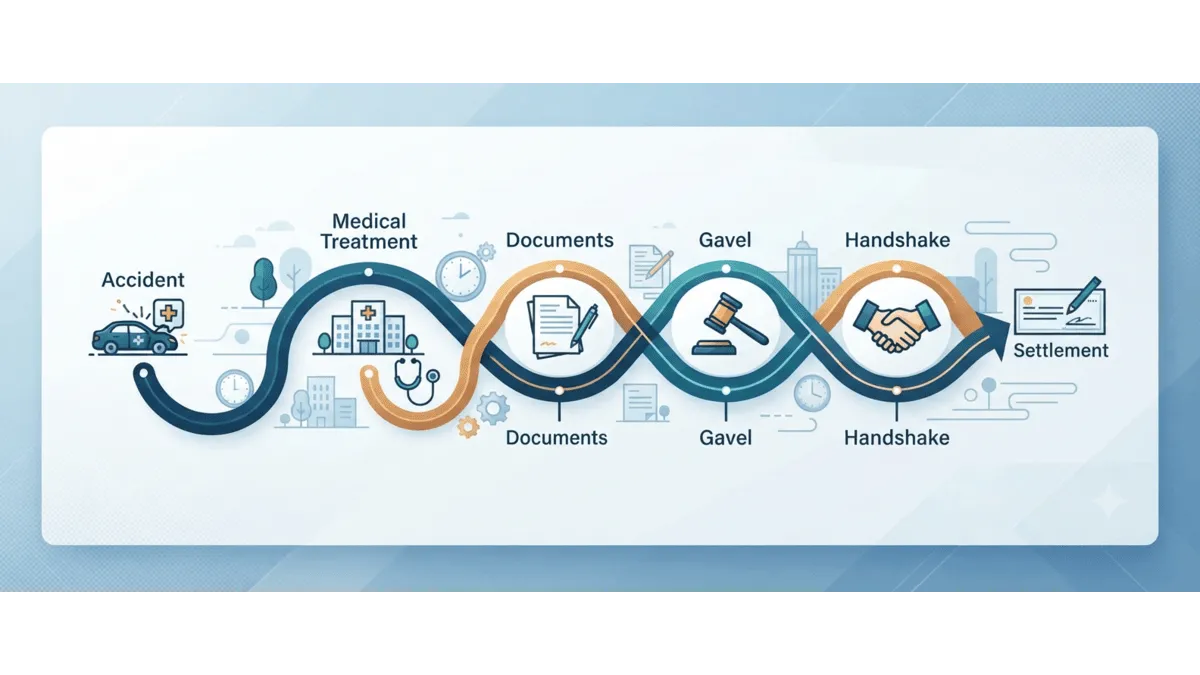
If you’ve recently been hurt in an accident and you’re already searching for answers about your legal options, there’s a good chance one question is keeping you up at night: how long is this actually going to take?
It’s a fair question, and unfortunately, it doesn’t have a one-size-fits-all answer. Some personal injury claims wrap up in a matter of months. Others stretch on for two, three, or even more years. The truth is, the timeline for your case depends on dozens of moving parts — the severity of your injuries, whether the at-fault party disputes responsibility, how backed up your local courts are, and even how quickly you follow through on medical treatment.
That said, you don’t have to go in blind. Based on 2026 industry data, court statistics, and how personal injury litigation actually plays out across the United States, this guide breaks down exactly what happens at each stage of a personal injury lawsuit — from the day you’re injured to the day you finally see a settlement check — and what typically causes cases to move faster or slower.
Quick Answer: The Short Version
Most personal injury claims resolve somewhere between 5 months and 2 years. According to recent industry data, the average personal injury claim now takes roughly 11 to 14 months to resolve when it settles before a lawsuit is even filed, while cases that proceed into full litigation typically take 18 months to 3 years from the date the lawsuit is filed to final resolution.
Here’s the breakdown that most personal injury attorneys use as a general framework:
- Simple, clear-liability cases: 5 to 7 months
- Moderate cases with some disputes or ongoing treatment: 8 to 18 months
- Complex or heavily litigated cases: 1 to 3+ years
Fewer than 5% of personal injury cases actually make it to trial — the overwhelming majority settle somewhere along the way. That’s important to understand up front, because “filing a lawsuit” doesn’t mean you’re locked into a courtroom battle. In many cases, filing the suit is exactly what pushes a stubborn insurance company to finally negotiate seriously.
Now let’s walk through the entire process, stage by stage.
Also Read – Do You Need a Personal Injury Lawyer for a Minor Car Accident in Florida?
Stage 1: Medical Treatment and Recovery (Weeks to Many Months)
Before your attorney can even think about a settlement demand, you need to reach what’s called maximum medical improvement (MMI) — the point where your doctors determine your condition has stabilized, whether that means a full recovery or a clear picture of any permanent limitations.
This stage alone can dramatically affect your timeline. Why? Because settling too early is one of the biggest mistakes an injured person can make. If you accept a settlement before you know the full extent of your injuries, you could be left covering future medical bills out of pocket, since most settlements require you to release the at-fault party from all further liability.
- Minor injuries (sprains, minor whiplash, superficial cuts): a few weeks to a few months of treatment.
- Moderate injuries (fractures, herniated discs, surgeries): 3 to 9 months of treatment and rehabilitation.
- Severe or catastrophic injuries (traumatic brain injury, spinal cord damage, multiple surgeries): a year or longer, sometimes with treatment continuing well after the legal case resolves.
Your attorney will typically wait until you’ve either fully recovered or reached a stable long-term prognosis before sending a demand letter. This is frustrating for a lot of clients who want closure quickly, but rushing this stage almost always costs you money in the long run.
Also Read – Rideshare Accidents (Uber/Lyft) in Florida: How Injury Claims Work Differently
Stage 2: Investigation and Evidence Gathering (Runs Parallel to Treatment)
While you’re healing, your attorney’s team is busy behind the scenes. This is where the groundwork for your entire case gets built, and in 2026, this stage looks noticeably different than it did even five years ago.
Modern personal injury investigations increasingly rely on:
- Vehicle telematics and event data recorders that capture speed, braking, and impact force in the seconds before a crash
- Dashcam and surveillance footage, often pulled from nearby businesses, traffic cameras, or the vehicles involved
- 3D accident reconstruction software that models exactly how a collision occurred
- Electronic medical records requested directly from providers to establish a clear treatment timeline
- Cell phone and app data in cases involving distracted driving
If liability is obvious — say, a rear-end collision where the police report clearly places fault on the other driver — this phase moves quickly. If liability is disputed, this stage can take considerably longer, since your attorney needs to build a strong evidentiary foundation before ever approaching the insurance company.
Stage 3: The Demand Letter and Pre-Litigation Negotiation (1 to 4 Months)
Once you’ve reached MMI and your attorney has compiled your medical records, bills, lost wage documentation, and evidence, they’ll draft a demand letter. This document lays out:
- What happened and who was at fault
- The full extent of your injuries and treatment
- Your economic damages (medical bills, lost income, future care costs)
- Your non-economic damages (pain and suffering, loss of enjoyment of life)
- A specific dollar amount you’re demanding in settlement
The insurance company then reviews the letter, and negotiations begin. This back-and-forth typically plays out over one to four months, though it can move faster in straightforward cases or drag on longer if the insurer is playing hardball.
Here’s an important note for 2026: insurance companies are increasingly using AI-assisted claims software to evaluate demand letters, which has actually sped up the initial review process for many insurers — but it’s also made them more likely to issue lowball opening offers that require a firmer counter-negotiation from your attorney.
If negotiations stall or the insurance company refuses to offer fair compensation, this is when your attorney will typically recommend filing a lawsuit.
Also Read – Hit-and-Run Car Accidents in Florida: What Are Your Legal Options and Insurance Coverage?
Stage 4: Filing the Lawsuit
Filing a lawsuit is a formal legal action, but it’s worth repeating: it does not mean your case is headed to trial. In fact, filing often accelerates settlement, because it signals to the insurance company and defense counsel that you’re serious and prepared to go the distance.
Statute of Limitations: Don’t Wait Too Long
Every state sets a deadline — called the statute of limitations — for how long you have to file a personal injury lawsuit after an accident. Waiting too long to consult an attorney can permanently bar you from recovering compensation, even if your case is otherwise strong.
Deadlines vary significantly by state:
| Filing Deadline | Example States |
|---|---|
| 1 year | Kentucky, Louisiana, Tennessee |
| 2 years | California, Texas, Ohio, Florida* |
| 3 years | New York, Illinois, Wisconsin, New Jersey |
| 4 years | Arizona, Nevada, Utah |
| 6 years | Minnesota, North Dakota, Maine |
*Florida’s personal injury statute of limitations was shortened from four years to two years for injury claims arising after March 2023 — a good example of how these laws can change, which is exactly why you should never rely on outdated information found online without confirming current law with a licensed attorney in your state.
A few important nuances:
- Claims against government entities (a city, county, or state agency) usually require a formal notice of claim within 60 to 180 days of the injury — far shorter than the general statute of limitations — or the claim can be barred entirely.
- The discovery rule can delay the start of the clock in cases where an injury wasn’t immediately apparent, such as some medical malpractice or toxic exposure cases.
- Settlement negotiations do not pause the clock. If your case is close to the filing deadline while you’re still negotiating with an insurer, your attorney will typically file the lawsuit anyway just to protect your rights, even if talks are progressing.
Also Read – Who Is at Fault in a Multi-Car Pileup on the Florida Interstate?
Stage 5: Discovery — The Longest Phase (6 to 18+ Months)
Once the lawsuit is filed and both sides have answered the initial pleadings, the case enters discovery — widely considered the longest and most labor-intensive phase of any personal injury lawsuit. This is where both sides formally exchange information and build their case for trial (even if trial never actually happens).
Discovery typically includes:
- Interrogatories — written questions each side must answer under oath
- Requests for production — turning over documents like medical records, maintenance logs, or company policies
- Depositions — sworn, recorded testimony from the plaintiff, defendant, witnesses, and expert witnesses (doctors, accident reconstructionists, economists)
- Independent medical examinations (IMEs) — the defense often has the right to have you examined by their own chosen doctor
- Expert witness disclosures — both sides typically retain expert witnesses to testify about liability, damages, or future medical needs
Discovery generally lasts six months to a year and a half, though in complex cases involving multiple defendants, catastrophic injuries, or corporate/product liability defendants, it can run considerably longer. This is also the stage where most of the “waiting” that frustrates clients happens — court scheduling, attorney availability, and the sheer volume of paperwork all contribute to delays.
Stage 6: Mediation and Settlement Conferences
Somewhere during or after discovery — and sometimes more than once — the parties will typically attempt mediation, where a neutral third-party mediator helps both sides negotiate toward a resolution without going to trial. Many courts now require at least one mediation attempt before a case can proceed to trial.
Mediation sessions usually last a single day, though complex cases can require multiple sessions. This is often where cases finally settle, since both sides now have a clearer picture of the evidence, expert opinions, and potential jury outcomes after discovery has concluded.
If mediation fails, the case proceeds toward trial — though settlement negotiations frequently continue right up until (and sometimes during) the trial itself.
Stage 7: Trial (If the Case Doesn’t Settle)
Here’s where 2026’s court backlog reality comes into play. Even after a case is fully prepared for trial, getting an actual trial date can take considerably longer than it used to.
According to recent federal court data, the median time from filing to trial in U.S. district courts has generally hovered in the 33- to 38-month range in recent reporting periods, though this varies enormously by jurisdiction — some state courts move much faster, while others, especially larger urban counties, have civil dockets stretched thin by rising filing volumes. Many personal injury attorneys report that, depending on the county and state, getting a trial date currently takes anywhere from 9 to 24 months after a lawsuit is filed.
A few things worth knowing about trial in 2026:
- The vast majority of cases still settle before trial. Recent industry estimates put the number of personal injury cases that actually reach trial at somewhere between 4% and 5% — meaning roughly 95 out of 100 filed lawsuits resolve through settlement rather than a verdict.
- Court backlogs remain uneven across the country. Some jurisdictions have made real progress clearing pandemic-era case backlogs and expanding judicial resources, while others — particularly high-population counties — continue to see civil filings rise faster than courts can process them.
- Trial itself is usually short relative to the rest of the process. Once a case actually reaches the courtroom, most personal injury trials last anywhere from a single day to about two weeks, depending on complexity.
- Settling “on the courthouse steps” is common. It’s not unusual for a case to settle the morning of trial, or even during jury selection, once both sides see how serious the other is about proceeding.
Stage 8: Post-Settlement or Post-Verdict Wrap-Up (2 to 8 Weeks)
Even after you agree to a settlement or a jury returns a verdict, there’s usually still a bit of a wait before money actually reaches your bank account. This final stage typically includes:
- Signing a release of liability
- Resolving medical liens (health insurers, Medicare, Medicaid, or hospitals with liens on your settlement often need to be paid or negotiated down)
- Your attorney’s office processing the settlement check and disbursing funds
- Deducting attorney’s fees, case costs, and any outstanding liens before you receive your net payout
This final administrative stage generally takes two to eight weeks, though lien negotiations — especially with Medicare or Medicaid — can occasionally add extra time.
How Long Does Each Type of Personal Injury Case Typically Take?
Not all personal injury cases move at the same pace. Here’s a general breakdown by case type, based on recent industry and government data:
| Case Type | Typical Timeline |
|---|---|
| Simple auto accident (clear liability, minor injury) | 5 to 9 months |
| Moderate auto accident (some disputes, ongoing treatment) | 8 to 20 months |
| Slip and fall / premises liability | 3 to 24 months |
| Motorcycle accident | 8 months to 2+ years |
| Product liability | 1 to 3+ years |
| Medical malpractice | 1.5 to 4+ years |
| Wrongful death | 1 to 3+ years |
| Mass tort / multi-district litigation (MDL) | 2 to 6+ years |
Medical malpractice and product liability cases tend to take the longest, largely because they require extensive expert testimony, and defendants (hospitals, insurers, manufacturers) typically have deep resources to fight claims aggressively rather than settle quickly.
Factors That Speed Up a Personal Injury Case
If you’re hoping to resolve your claim as quickly as possible, these factors tend to help:
- Clear liability. When fault isn’t seriously in dispute, insurers have less incentive to drag things out.
- Complete and well-documented medical treatment. Gaps in treatment or missed appointments give insurers ammunition to argue your injuries weren’t serious or weren’t caused by the accident.
- Reaching MMI relatively quickly. The sooner your medical picture is finalized, the sooner a demand letter can go out.
- Adequate insurance coverage. When the at-fault party has sufficient policy limits to cover your damages, there’s less need for prolonged litigation to chase additional compensation.
- A responsive, organized plaintiff. Promptly returning documents, attending depositions, and cooperating with your attorney keeps your case moving instead of sitting in a pile.
- Working with an experienced trial attorney. Insurance companies keep track of which law firms are willing to actually go to trial versus those known for settling quickly and cheaply. A firm with a credible trial record often gets better, faster offers.
Factors That Slow Down a Personal Injury Case
On the flip side, these are the most common reasons cases take longer than expected:
- Disputed liability. If the at-fault party denies responsibility or claims you were partially at fault (comparative negligence), expect a longer fight.
- Severe or catastrophic injuries. More serious injuries mean longer treatment, more medical experts, and higher settlement demands that insurers scrutinize more closely.
- Multiple defendants or insurance carriers. Coordinating between several parties and their attorneys naturally slows negotiations and litigation.
- Government defendants. Suing a city, county, or state agency involves additional procedural hurdles, shorter notice deadlines, and often caps on damages.
- Underinsured or uninsured at-fault parties. These cases may require pursuing your own uninsured/underinsured motorist coverage, adding another layer of negotiation.
- Court backlogs in your jurisdiction. As noted above, some counties simply have more cases than judges and courtrooms can handle promptly.
- Appeals. If either side appeals a verdict, add another year or more before the case is truly final.
- Bankruptcy of the defendant or their insurer. Though rare, this can pause litigation entirely while bankruptcy proceedings play out.
What About Settlement Amounts — Does a Longer Case Mean More Money?
Not necessarily, but there is some correlation. Recent data shows that plaintiffs represented by an attorney recover significantly more, on average, than those who represent themselves or accept an insurer’s first offer — some studies show represented claimants receiving payouts several times higher than unrepresented claimants. Cases that proceed further into litigation often do so because the stakes are higher or liability is contested, which naturally correlates with larger claims. However, a longer timeline isn’t a guarantee of a bigger settlement — it usually just reflects a more complicated case.
How to Keep Your Case Moving as Quickly as Possible
While you can’t control court schedules or how aggressively an insurance company fights, there are things within your control:
- See a doctor immediately and follow through on all recommended treatment without gaps.
- Keep detailed records — medical bills, missed work documentation, photos of injuries and property damage, and a personal journal of how your injuries affect daily life.
- Avoid posting about your accident or injuries on social media. Insurance companies and defense attorneys routinely monitor plaintiffs’ public posts for anything that could undermine your claim.
- Respond promptly to requests from your attorney for documents, depositions, or medical exams.
- Be patient with the discovery process — pushing to rush it can actually weaken your case if evidence isn’t fully developed.
- Choose your attorney carefully. Ask about their trial experience, their typical case timelines, and how they communicate with clients during long waiting periods.
Frequently Asked Questions
Does filing a lawsuit mean my case is going to trial?
Ans: No. Filing a lawsuit simply starts the formal litigation process. The vast majority of personal injury lawsuits — around 95% — settle before ever reaching a jury.
Can I settle my case after filing a lawsuit but before trial?
Ans: Yes, absolutely. In fact, most lawsuits settle during or shortly after discovery, or during mediation, well before a trial date ever arrives.
What happens if I miss my state’s statute of limitations?
Ans: In almost all cases, missing the filing deadline permanently bars you from pursuing compensation through the courts, regardless of how strong your case might otherwise be. There are limited exceptions, such as cases involving minors or the discovery rule, but you should never assume an exception applies without confirming with an attorney.
Why does my case seem to be moving so slowly?
Ans: Discovery is almost always the longest phase, and much of it happens behind the scenes — document review, depositions, and waiting on medical records or expert reports. Court backlogs in many jurisdictions have also extended the time it takes to get an actual trial date, even though most cases never need one.
Should I accept an early settlement offer to speed things up?
Ans: Generally, it’s risky to accept a settlement before reaching maximum medical improvement, since you typically can’t reopen a case for additional compensation later if your injuries turn out to be worse than initially expected. Early offers are often lower than what your claim is actually worth.
Do all personal injury cases eventually settle?
Ans: No, though most do. A small percentage go to trial, and an even smaller percentage are dismissed, dropped, or resolved through other means, such as arbitration.
The Bottom Line
There’s no universal timeline for a personal injury lawsuit — anyone who promises you an exact date is guessing. What you can count on is a general pattern: medical treatment and investigation first, negotiation next, and — if a fair settlement isn’t reached — formal litigation involving discovery, mediation, and, in rare cases, trial.
Most claims resolve somewhere between five months and two years, with straightforward cases on the faster end and complex, disputed, or catastrophic injury cases taking considerably longer. Understanding where your case falls in this process — and why each stage takes the time it does — can make the wait far less frustrating, even when it feels like nothing is happening.
If your case has been dragging on longer than you expected, don’t hesitate to ask your attorney for a clear explanation of exactly where things stand and what’s next. A good personal injury lawyer should be able to walk you through your case’s specific timeline, not just industry averages.
DISCLAIMER: This article is for general informational purposes only and does not constitute legal advice. Personal injury laws, including statutes of limitations, vary by state and are subject to change. Consult a licensed personal injury attorney in your state to discuss the specific facts and deadlines that apply to your case.

About Jordan
Jordan is a content writer at SushilHelps, covering legal topics such as car accidents, personal injury claims, medical compensation, and marriage visas. Jordan focuses on providing clear, practical, and easy-to-understand information to help readers navigate legal and immigration processes across major international destinations. He is not an attorney and does not provide legal advice, but his work is backed by thorough research and a commitment to accuracy. Spotted something that needs a correction? Let us know.