Planning to move to Spain after marrying your partner? If you are a foreign national and your spouse lives in Spain, you may be able to apply for a residence visa or family reunification route that allows you to join them legally.
However, Spain does not have one single “marriage visa” for every couple. The correct immigration route depends mainly on your spouse’s nationality and legal status in Spain.
If your spouse is a Spanish citizen, you may qualify for residence as a family member of a Spanish national. If your spouse is a foreign citizen legally living in Spain, the general family reunification procedure may apply.
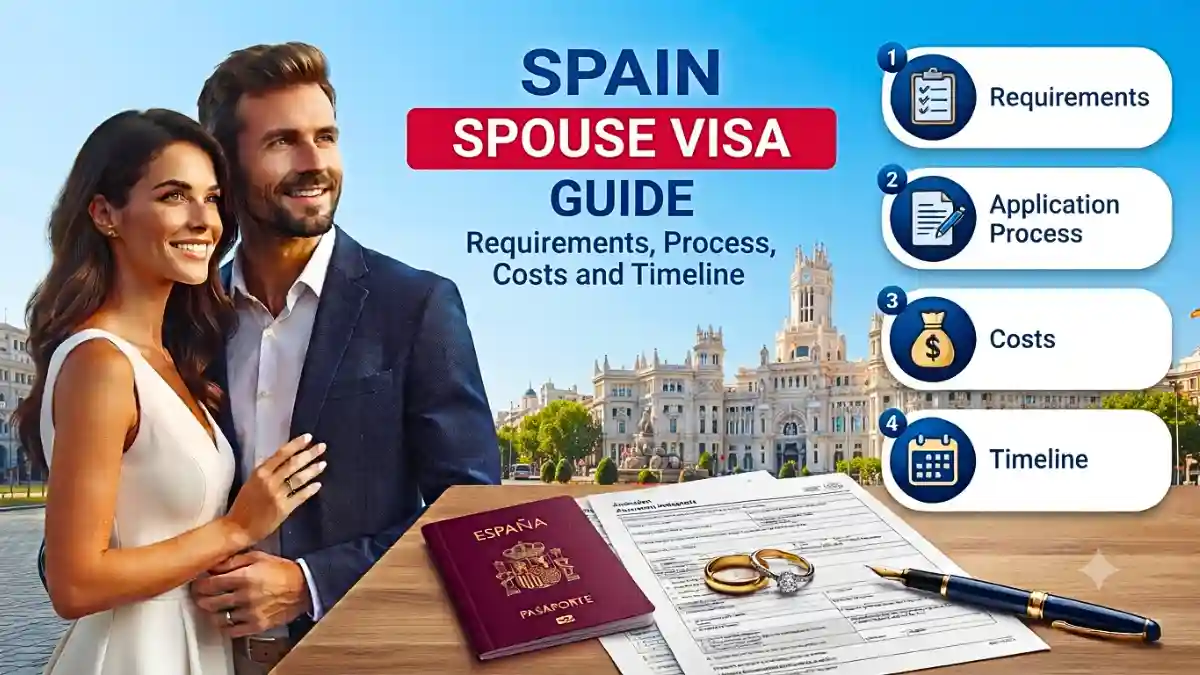
This guide explains the main Spain spouse visa requirements, documents, application process, costs, and expected timeline.
Who Can Apply for a Spain Spouse Visa?
The requirements depend on your spouse’s status.
If Your Spouse Is a Spanish Citizen
A non-EU/EEA/Swiss citizen married to a Spanish citizen may qualify for residence as a family member of a Spanish national. The marriage must be legally valid and must not have been annulled or dissolved.
The applicant generally needs to be at least 18 years old and provide official evidence of the marriage.
If Your Spouse Is a Foreign Resident
If your spouse is a foreign national who legally resides in Spain, you may qualify under Spain’s family reunification system.
In this situation, the spouse living in Spain generally needs to meet certain residence, financial, accommodation, and health-insurance requirements before the application can proceed.
Spain Spouse Visa Requirements
While the exact requirements vary depending on your situation, applicants commonly need the following documents.
1. Valid Passport
You will need a valid passport and copies of the relevant pages. Make sure your passport meets the validity requirements of the Spanish consulate handling your application.
2. Marriage Certificate
Your marriage certificate is one of the most important documents.
It must prove that your marriage is legally recognized. If it was issued outside Spain, it may need to be apostilled or legalized and translated into Spanish by an authorized or sworn translator, depending on the document and applicable rules.
3. Proof of Your Spouse’s Status
You will need evidence showing that your spouse is legally entitled to sponsor or support your residence application.
This may include your spouse’s Spanish passport or DNI if they are Spanish, or their Spanish residence documentation if they are a foreign resident.
4. Proof of Financial Resources
Financial requirements are particularly important for applications under the general family reunification route.
The resident spouse generally needs to demonstrate sufficient and stable income to support the family. Spain’s official guidance uses IPREM-based thresholds for family reunification, with the required amount depending on the size of the family.
Evidence may include employment contracts, payslips, tax documents, or other proof of regular income.
5. Proof of Accommodation
For general family reunification, the sponsoring spouse may need to demonstrate that suitable accommodation is available in Spain.
Depending on the circumstances, an official housing report may be required to confirm that the property is appropriate for the family.
6. Criminal Record Certificate
Adult applicants may be asked to provide criminal record certificates from countries where they have lived during the relevant period.
These documents may also need legalization or apostille and an official Spanish translation.
7. Medical Certificate
A medical certificate may be required to confirm that the applicant does not have a disease that falls under the applicable international health regulations.
8. Passport Photos and Application Forms
You will normally need recent passport-size photographs and the appropriate Spanish visa or residence application forms.
The exact format and number of photographs should be checked with the relevant Spanish consulate.
Spain Spouse Visa Documents Checklist
Before applying, prepare the documents that apply to your case, such as:
- Valid passport
- Completed visa application form
- Recent passport photographs
- Marriage certificate
- Proof of spouse’s Spanish citizenship or legal residence
- Proof of financial resources, where required
- Proof of suitable accommodation, where required
- Criminal record certificate
- Medical certificate
- Proof of health insurance, where applicable
- Documents relating to previous marriages, if applicable
- Apostille or legalization of foreign documents, where required
- Official Spanish translations
The Spanish consulate can request additional documents depending on your individual circumstances.
Spain Marriage Visa Application Process
The process usually involves several stages.
Step 1: Choose the Correct Immigration Route
First, determine whether you are applying as the spouse of a Spanish citizen, through general family reunification, or under another applicable EU family-member procedure.
This is important because the requirements and application process can be different.
Step 2: Prepare Your Documents
Collect your marriage certificate, passport, proof of your spouse’s status, financial evidence, criminal record certificate, medical documents, and other required paperwork.
Arrange apostilles, legalizations, and translations before submitting the application if they are required.
Step 3: Apply for Residence Authorization When Required
Under the general family reunification route, the spouse already living in Spain normally starts the residence authorization process with the relevant immigration authority.
Spain’s official guidance states that the general decision period for this residence authorization is up to two months.
Step 4: Apply for the Visa
After the residence authorization is approved, the spouse living outside Spain applies for the visa at the appropriate Spanish embassy or consulate.
For general family reunification, the official guidance provides a limited period after approval in which the applicant must submit the visa application.
Step 5: Attend the Appointment
The applicant may need to attend a consular appointment and provide original documents and copies.
The consulate may ask questions about the marriage, relationship, residence arrangements, or other aspects of the application.
Step 6: Receive the Visa and Travel to Spain
If the application is approved, you can collect your visa and travel to Spain within the applicable validity period.
After arriving, you may need to apply for a Foreigner Identity Card (TIE) within the required timeframe.
How Long Does a Spain Spouse Visa Take?
There is no single processing time for every Spain spouse visa application.
For general family reunification, the official residence authorization process can take up to two months, followed by the visa stage. The consular processing period can take additional time depending on the consulate and individual case.
Your overall timeline can be longer because of:
- Document preparation
- Apostille or legalization
- Translation
- Appointment availability
- Additional document requests
- Administrative delays
For this reason, it is better to start preparing your documents well before your intended move to Spain.
How Much Does a Spain Marriage Visa Cost?
The total cost depends on the immigration route, your nationality, the Spanish consulate handling your application, and the documents you need.
Possible expenses include:
- Visa or residence application fees
- Document legalization or apostille fees
- Translation fees
- Criminal record certificate fees
- Medical certificate costs
- Travel expenses
- TIE card fees
Because fees can change, applicants should check the latest fee information from the Spanish consulate or immigration authority before applying.
Can a Spouse Work in Spain?
Under the general family reunification route, the residence authorization granted to a reunited spouse of working age generally allows them to work in Spain as an employee or self-employed person without needing a separate work authorization.
However, work rights can depend on the specific residence status granted, so applicants should check their authorization carefully.
Common Reasons for Delays
Many spouse visa applications are delayed because of incomplete or inconsistent documentation.
Common problems include:
- Missing marriage documents
- Incorrect application forms
- Expired certificates
- Missing apostille or legalization
- Incorrect translations
- Insufficient financial evidence
- Problems with accommodation documents
- Inconsistent personal information
- Applying under the wrong immigration category
Carefully checking every document before submission can help avoid unnecessary delays.
Final Thoughts
A Spain marriage visa can provide a legal pathway for married couples to live together in Spain, but the correct procedure depends on your spouse’s nationality and residence status.
If your spouse is a Spanish citizen, you may qualify for residence as a family member of a Spanish national. If your spouse is a foreign resident, the general family reunification procedure may be the appropriate route.
Start by identifying the correct immigration category, then prepare your marriage certificate, passport, financial evidence, accommodation documents, criminal record certificate, medical certificate, translations, and any required legalization or apostille.
Since Spanish immigration rules and fees can change, always check the latest information from the Spanish Ministry of Inclusion and the Spanish embassy or consulate responsible for your application before submitting your documents.
Disclaimer: This article is for general informational purposes only and does not constitute legal advice. Spanish immigration rules can change, so applicants should verify the latest requirements with the relevant Spanish authorities or a qualified immigration professional before applying.

About Jordan
Jordan is a content writer at SushilHelps, covering legal topics such as car accidents, personal injury claims, medical compensation, and marriage visas. Jordan focuses on providing clear, practical, and easy-to-understand information to help readers navigate legal and immigration processes across major international destinations. He is not an attorney and does not provide legal advice, but his work is backed by thorough research and a commitment to accuracy. Spotted something that needs a correction? Let us know.