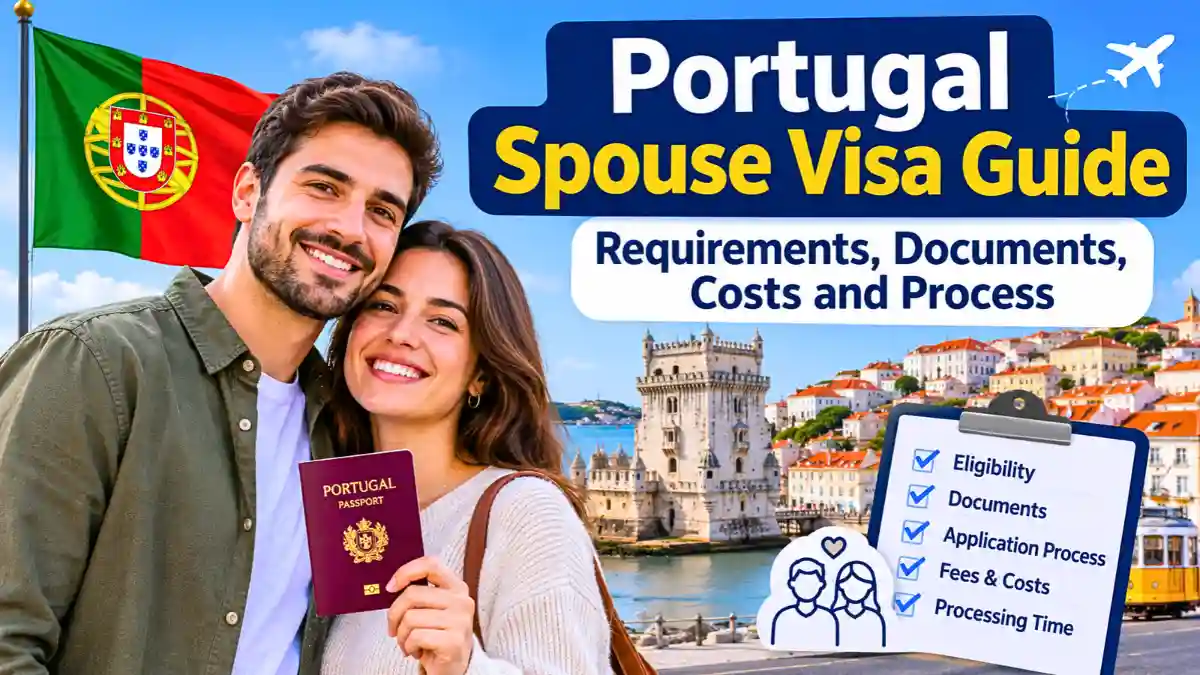
Portugal Spouse Visa Guide: Requirements, Documents, Costs and Process is an essential resource for couples planning to live together in Portugal. Whether you are married to a Portuguese citizen or your spouse already holds a valid Portuguese residence permit, understanding the family reunification process can help you prepare a stronger application.
Portugal offers family reunification options that allow eligible foreign nationals to join their spouses and establish a life together in the country. However, the requirements, application procedure and waiting periods depend on the immigration status of the spouse living in Portugal.
Recent changes to Portuguese immigration legislation, particularly Law No. 61/2025, have also introduced new conditions for family reunification applications. Therefore, applicants should understand the latest rules before making travel or relocation plans. DR+1
This Portugal Spouse Visa Guide explains Portugal’s spouse visa requirements, eligible applicants, necessary documents, application costs, processing stages and frequently asked questions.
What Is a Portugal Spouse Visa?
A Portugal spouse visa is an immigration route that allows an eligible foreign spouse to join their husband or wife in Portugal and obtain permission to live there.
For non-EU nationals joining a foreign resident in Portugal, this process generally falls under family reunification (D6 visa).
The application involves two main stages:
- The spouse already living in Portugal applies for family reunification through the Agency for Integration, Migration and Asylum (AIMA).
- After approval, the spouse living abroad applies for a residence visa through the appropriate Portuguese embassy or consulate.
The visa allows the applicant to travel to Portugal and complete the residence permit process.
There are different rules for spouses of Portuguese citizens and EU/EEA citizens. They may follow separate family-member residence procedures rather than the standard D6 route.
Also Read – Belgium Spouse Visa Guide: Requirements, Process and Costs
Who Can Apply for a Portugal Spouse Visa?
Eligibility depends on the immigration status of the person living in Portugal.
Generally, the following categories may qualify:
- Spouse of a Portuguese citizen: A foreign husband or wife may apply through the relevant family-member residence procedure.
- Spouse of a foreign resident: A person whose husband or wife holds a valid Portuguese residence permit may qualify for family reunification.
- Spouse of an eligible student or researcher: Certain residence categories have specific family reunification provisions.
- Spouse of a refugee: Recognised refugees may benefit from separate family reunification provisions.
Applicants must have a genuine and legally recognised marital relationship. Portuguese law also requires both spouses to be at least 18 years old when the family reunification application is submitted.
Portugal Spouse Visa Requirements
Before applying, couples should understand the main eligibility conditions.
- Valid marriage: The marriage must be legally valid and recognised under Portuguese law. A marriage certificate is generally required.
- Sponsor’s residence status: If the sponsor is a foreign national, they must hold an eligible Portuguese residence authorisation.
- Minimum residence period: Under the rules introduced by Law No. 61/2025, the general requirement is that the sponsor must have held a valid residence permit for at least two years before applying for family reunification.
- However, important exceptions apply. For example, the period is reduced to 15 months where the spouse lived together with the sponsor for at least 18 months immediately before the sponsor entered Portugal. The waiting period does not apply in certain cases, including where the couple has a dependent minor or incapacitated child together. Other statutory exceptions may also apply.
- Financial stability: The sponsor must demonstrate sufficient financial resources to support the household without relying on social assistance.
- Suitable accommodation: Evidence must show that the couple has appropriate accommodation in Portugal.
- Genuine relationship: Authorities may examine the marriage documentation and request additional evidence where necessary.
- Criminal record: Applicants may need to provide criminal record certificates and satisfy applicable public-security requirements.
These conditions are particularly important for couples applying under the standard family reunification route. DR+2
Documents Required for a Portugal Spouse Visa
Preparing the correct documents is one of the most important parts of the application. Missing, outdated or improperly authenticated documents can cause delays or lead to additional requests from immigration authorities.
The following documents are commonly required.
Documents from the spouse applying for the visa
- Valid passport: A passport with sufficient validity and available blank pages.
- Visa application form: The completed and signed national residence visa application form.
- Recent photographs: Passport-sized photographs meeting Portuguese visa specifications.
- Marriage certificate: An official marriage certificate proving the legal relationship.
- Criminal record certificate: A police clearance certificate from the relevant country or countries of residence, as required.
- Travel medical insurance: Insurance covering medical emergencies and repatriation during the relevant travel period.
- Proof of accommodation: Evidence showing where the applicant will live in Portugal.
- AIMA approval notification: Confirmation that the family reunification request has been approved.
- Portuguese criminal record authorisation: The required declaration allowing Portuguese authorities to consult the applicant’s criminal record.
Documents from the spouse living in Portugal
The sponsoring spouse may need to provide:
- A valid Portuguese residence permit or relevant identification document.
- A copy of the applicant’s passport.
- An authenticated marriage certificate.
- Proof of sufficient financial resources.
- Proof of accommodation, such as a rental agreement or property ownership documentation.
- Recent bank statements, employment documents or other evidence of income.
- A declaration of responsibility, where applicable.
Additional documents that may be requested
Depending on the circumstances, immigration authorities may request:
- Previous marriage and divorce certificates, if applicable.
- Evidence of the couple’s shared residential history.
- Joint financial documents or other evidence supporting the relationship.
- Certified translations of foreign-language documents.
- Apostilles or other legalisation of official certificates.
Important: Document requirements can differ according to the applicant’s nationality, country of residence and consular jurisdiction. Always follow the latest checklist issued by the relevant Portuguese embassy or visa application centre.
Portugal Spouse Visa Application Process
The Portugal spouse visa process involves several stages. Couples should understand the order of these steps before submitting an application.
Step 1: Check eligibility
- First, confirm that the sponsor meets the applicable residence requirements and that the marriage is legally recognised in Portugal.
- If the sponsor is a foreign resident, check whether the two-year residence requirement or one of its exceptions applies.
Step 2: Apply for family reunification through AIMA
- The spouse living in Portugal generally initiates the family reunification procedure with AIMA.
- The application must include the required documents, such as the sponsor’s residence permit, marriage certificate, passport copy, accommodation evidence and financial documentation.
- The application is submitted through the applicable AIMA procedure, which may require an appointment and an in-person submission.
Step 3: Wait for AIMA’s decision
- AIMA examines the application and supporting documents. Authorities may request additional information or clarification if necessary.
- Once family reunification is approved, the applicant receives the relevant notification.
Step 4: Apply for the D6 residence visa
The spouse living abroad can then apply for a family reunification residence visa at the Portuguese embassy or consulate responsible for their country of residence.
Applicants should submit:
- The completed visa application form.
- A valid passport.
- Recent photographs.
- AIMA’s family reunification approval.
- The required criminal record certificate.
- Travel medical insurance.
- Other documents specified in the consular checklist.
Depending on the country, applications may be submitted through an authorised visa application centre.
Step 5: Receive the visa and travel to Portugal
- After the visa application is approved, the applicant can receive their passport with the residence visa.
- The applicant should check the visa’s validity and entry conditions before travelling.
Step 6: Complete the residence permit procedure
- After arriving in Portugal, the spouse must follow the instructions provided by AIMA to complete the residence authorisation procedure.
- This may involve attending an appointment, providing biometric information and submitting any outstanding documents.
- Once approved, the applicant receives a Portuguese residence permit.
Portugal Spouse Visa Costs and Fees
The total cost of obtaining a Portugal spouse visa depends on the applicant’s circumstances, country of residence and the services required during the application.
Here is an overview of the main expenses.
| Expense | Estimated or published cost |
|---|---|
| D6 residence visa application | €90 |
| AIMA residence permit | Depends on applicable fee schedule |
| Document translation | Varies |
| Apostille or legalisation | Varies |
| Criminal record certificate | Varies |
| Medical or travel insurance | Depends on provider |
| Visa application centre service fee | Depends on location |
The Portuguese government lists the family reunification residence visa application fee as €90. Some eligible applicants may qualify for fee exemptions. gov.pt+1
Applicants should also budget for document preparation, translations, legalisation, travel and any applicable residence permit charges.
These additional costs are not necessarily included in the visa application fee.
Note: The €90 figure is the published general visa fee, not a guaranteed total application cost. Check the latest charges with the relevant Portuguese consular office before paying.
Also Read – Luxembourg Spouse Visa Guide: Requirements, Process and Costs
Portugal Spouse Visa Processing Time
Processing times can vary depending on the application category, document quality, AIMA workload and the relevant Portuguese consulate.
The family reunification process generally takes longer than a straightforward short-stay visa because it involves both AIMA approval and a subsequent residence visa application.
The main factors affecting processing time include:
- AIMA appointment availability.
- The time required to examine the family reunification application.
- Verification of marriage and other supporting documents.
- Requests for additional information.
- Embassy or consulate appointment availability.
- Visa processing and passport return arrangements.
Portuguese law provides a general decision period for family reunification applications, with extensions possible in complex cases. However, applicants should not assume that every case will be completed within a fixed number of months.
It is advisable to apply as early as possible and avoid making non-refundable travel arrangements before receiving the visa.
Can a Portugal Spouse Visa Holder Work?
Yes. A foreign national who receives a valid residence authorisation through family reunification generally has the right to work in Portugal, subject to the applicable legal conditions.
This means the spouse can generally:
- Work for a Portuguese employer.
- Explore employment opportunities.
- Start an eligible business or become self-employed.
- Access education and other services available under the applicable residence rules.
A residence permit also provides a legal basis for living in Portugal with the sponsoring spouse.
What Happens If a Portugal Spouse Visa Application Is Rejected?
A spouse visa or family reunification application may be refused if the applicant or sponsor does not meet the legal requirements.
Common reasons include:
- An invalid or insufficiently authenticated marriage certificate.
- Failure to meet the sponsor’s residence requirements.
- Insufficient financial resources.
- Inadequate accommodation evidence.
- Missing documents.
- Inconsistencies in the application.
- Relevant criminal or public-security concerns.
If an application is refused, carefully read the decision letter to understand the reasons.
Depending on the circumstances, the applicant may be able to challenge the decision through an administrative or judicial procedure.
If the refusal results from missing documentation or an easily correctable issue, obtaining appropriate legal advice before making another application can be helpful.
Can a Spouse Visa Lead to Permanent Residency or Portuguese Citizenship?
A family reunification residence permit can provide a pathway towards long-term residence in Portugal.
Foreign nationals who maintain continuous legal residence may become eligible to apply for permanent residence after meeting the applicable requirements, generally after five years of legal temporary residence.
Applicants must satisfy the relevant conditions, which may include:
- Maintaining legal residence in Portugal.
- Meeting the financial and accommodation requirements.
- Having an acceptable criminal record.
- Demonstrating basic knowledge of Portuguese.
Portuguese citizenship may also become an option after meeting the applicable nationality requirements. However, holding a spouse visa does not automatically grant permanent residence or citizenship.
Applicants should check the nationality rules in force when they become eligible.
Also Read – Ireland Spouse Visa Guide: Requirements, Process and Costs
Official Government Resources for Portugal Spouse Visa Applicants
Before applying, always verify the latest immigration requirements through official Portuguese government sources.
The following resources are particularly useful:
- AIMA – Agency for Integration, Migration and Asylum – Information about family reunification, residence permits and immigration procedures.
- Portuguese Government – Family Reunification Residence Visa – Official information about visa requirements, documents and application fees.
These resources can help applicants confirm the latest requirements before submitting their applications.
Portugal Spouse Visa Guide: Frequently Asked Questions (FAQs)
1. What is the Portugal spouse visa called?
For eligible non-EU family members joining a foreign national legally residing in Portugal, the relevant route is generally called the D6 Family Reunification Visa.
2. How much does a Portugal spouse visa cost?
The published general application fee for a family reunification residence visa is €90. Additional expenses may include document translation, legalisation, insurance and residence permit charges.
3. How long does it take to get a Portugal spouse visa?
There is no single processing time for every application. The overall timeline depends on AIMA’s family reunification decision, appointment availability and the subsequent consular visa process.
4. Can I bring my spouse to Portugal if I have a residence permit?
Yes, eligible foreign residents can generally apply for family reunification. However, the sponsor must meet the applicable residence period, financial and accommodation requirements, unless an exception applies.
5. Is there a two-year waiting period for Portugal family reunification?
Generally, yes. Under Law No. 61/2025, the standard requirement is two years of valid residence. However, certain exceptions apply, including specific circumstances involving spouses who previously lived together and couples with dependent minor children.
6. Can my spouse work in Portugal after receiving a residence permit?
Yes. Family members holding the relevant residence authorisation generally have the right to undertake employment or self-employment in Portugal.
7. Can I apply for a Portugal spouse visa without a marriage certificate?
A legally recognised marriage must be established for the spouse route. If you are in a recognised unmarried partnership, you may qualify under the separate de facto union provisions, subject to the relevant evidence requirements.
8. Can I apply for family reunification if my spouse is a Portuguese citizen?
Yes. However, spouses of Portuguese citizens generally follow a different family-member residence procedure rather than the standard D6 family reunification route.
9. Does a Portugal spouse visa lead to citizenship?
It can provide a route towards long-term residence and potentially citizenship, provided the applicant meets the relevant legal requirements. Citizenship is not automatic.
10. Can my spouse apply for a Portugal visa while I am living abroad?
The standard family reunification procedure generally requires the sponsor to be legally residing in Portugal and to initiate the application through AIMA. Different procedures may apply to spouses of Portuguese or EU citizens.
Conclusion
Portugal offers family reunification opportunities for eligible foreign nationals who want to live with their spouses in the country. However, obtaining a spouse visa requires careful preparation, valid relationship documents and compliance with the applicable immigration rules.
The introduction of Law No. 61/2025 has made it particularly important to understand the sponsor’s residence period and the exceptions available under Portuguese immigration legislation.
Before beginning the application, couples should check their eligibility, prepare the necessary financial and accommodation evidence, and confirm the latest document checklist with AIMA and the relevant Portuguese consulate.
With proper preparation and accurate documentation, applicants can make the family reunification process more organised and avoid unnecessary delays.
DISCLAIMER: This article is intended for general informational and educational purposes only. Portuguese immigration laws, visa fees and application procedures may change. Requirements can also vary depending on individual circumstances and nationality. Always consult AIMA, the Portuguese government or a qualified immigration professional before making immigration decisions.
Also Read – Finland Spouse Visa Guide: Requirements, Process and Costs

About Jordan
Jordan is a content writer at SushilHelps, covering legal topics such as car accidents, personal injury claims, medical compensation, and marriage visas. Jordan focuses on providing clear, practical, and easy-to-understand information to help readers navigate legal and immigration processes across major international destinations. He is not an attorney and does not provide legal advice, but his work is backed by thorough research and a commitment to accuracy. Spotted something that needs a correction? Let us know.