The United Arab Emirates (UAE) is a popular destination for international professionals, entrepreneurs and families. Many foreign nationals move to the country for employment or business opportunities and eventually want their spouses to join them.
The UAE offers a family residence visa that allows eligible expatriate residents to sponsor their husband or wife and live together in the country. This is commonly known as a UAE spouse visa.
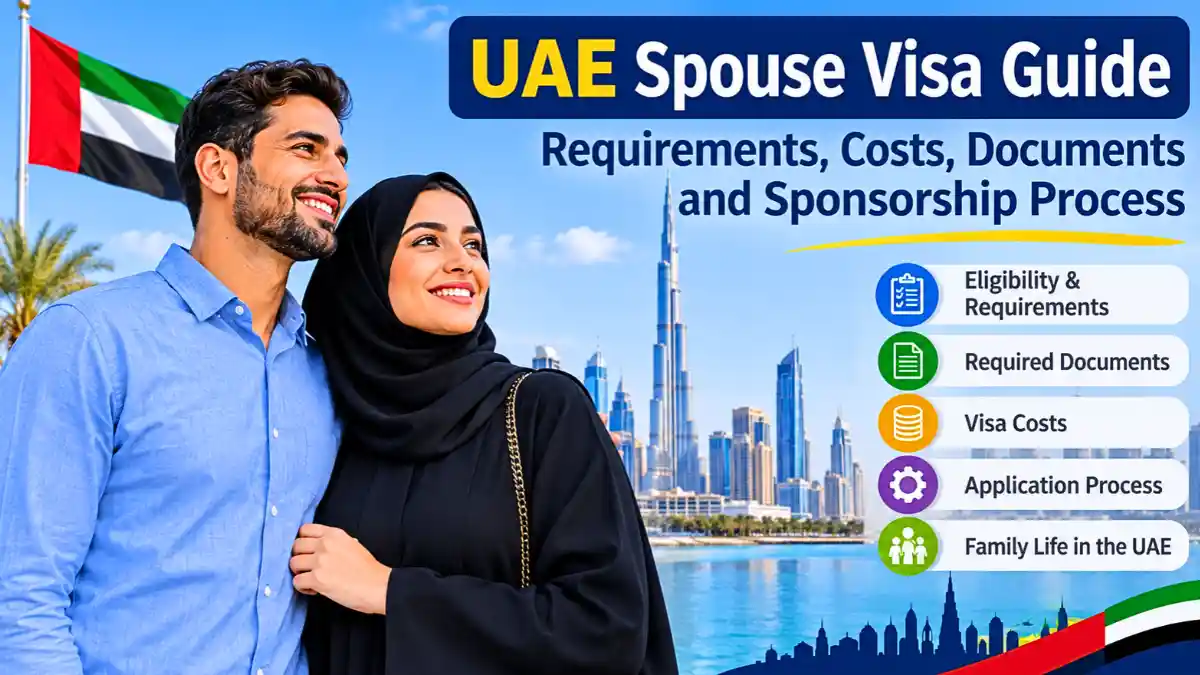
However, obtaining a spouse visa involves meeting specific sponsorship requirements, preparing the correct documents, proving the marital relationship and completing the relevant immigration procedures.
In this UAE Spouse Visa Guide, we explain the UAE spouse visa requirements, minimum salary, documents, application process, estimated costs and renewal rules to help couples understand how the system works in 2026.
What Is a UAE Spouse Visa?
A UAE spouse visa is a family residence permit that allows an eligible foreign resident to sponsor their legally married husband or wife to live in the UAE.
Unlike an employment visa, the spouse’s residence permission is based on their relationship with the sponsoring resident rather than a separate job offer.
The sponsoring person must have a valid UAE residence permit and meet the financial and accommodation requirements established by the immigration authorities.
Both male and female expatriate residents can generally sponsor eligible family members, provided they satisfy the applicable conditions.
A spouse residence visa may be issued for a period linked to the sponsor’s residence status. The validity can vary depending on the sponsor’s visa category and the relevant immigration authority.
Also Read – Greece Spouse Visa Guide: Family Reunification Requirements and Process
UAE Spouse Visa Requirements in 2026
Before applying, couples should make sure that the sponsoring resident and the sponsored spouse meet the necessary eligibility conditions.
Minimum Salary Requirement
One of the most important requirements is the sponsor’s monthly income.
According to the UAE government’s family residence visa guidance, an expatriate resident generally needs:
- A minimum monthly salary of AED 4,000; or
- AED 3,000 per month plus accommodation provided by the employer.
These requirements apply regardless of the sponsor’s job title. The immigration authority may also request evidence of employment and suitable accommodation.
Valid UAE Residence Visa
The sponsor must hold a valid UAE residence permit. A person staying in the country only on a tourist or visit visa cannot normally sponsor a spouse under the standard expatriate family residence route.
Proof of Marriage
The couple must provide official evidence of their legal marriage.
A marriage certificate issued outside the UAE generally needs the appropriate authentication or attestation and an Arabic translation by a certified legal translator.
The authorities may request additional verification depending on the country where the marriage was registered.
Suitable Accommodation
The sponsor must demonstrate that suitable accommodation is available for the family.
This may involve providing a registered tenancy contract, housing documentation or other accepted proof of residence.
Medical Fitness
Sponsored family members aged 18 or above must undergo and pass the UAE medical fitness examination at an approved medical centre.
The examination is part of the residence process and must meet the applicable UAE health regulations.
Health Insurance
Valid health insurance may be required depending on the emirate and applicable residence regulations. Dubai and Abu Dhabi have their own health insurance requirements, so applicants should check the relevant local rules.
These are the general requirements. Additional conditions may apply depending on the sponsor’s residence category and location.
Official reference: UAE Government – Residence Visa for Family Members.
Documents Required for a UAE Spouse Visa
Preparing the correct paperwork is essential because missing or incorrectly attested documents can delay an application.
The following documents are commonly required.
Documents from the sponsoring spouse:
- Copy of a valid passport.
- Copy of a valid UAE residence permit.
- Emirates ID.
- Recent salary certificate from the employer.
- Employment contract or other accepted proof of income.
- Registered tenancy contract or suitable accommodation proof.
- Recent utility bill, if requested by the relevant authority.
Documents from the sponsored spouse:
- Copy of a valid passport.
- Recent passport-size photograph with a white background.
- Attested marriage certificate.
- Certified Arabic translation of the marriage certificate, where required.
- Medical fitness certificate for applicants aged 18 or above.
- Health insurance documentation, where applicable.
- Entry permit or current UAE entry-status details, depending on the application route.
Important: The exact document checklist can differ between Dubai and other emirates. Applicants should check the requirements of the relevant authority before submitting their applications.
UAE Spouse Visa Application Process: Step by Step
The UAE spouse visa process generally involves obtaining an entry permit, completing medical examinations where required, applying for residence status and obtaining an Emirates ID.
Here is how the process usually works.
Step 1: Check Your Sponsorship Eligibility
The first step is to confirm that the sponsoring spouse meets the minimum salary requirement and has a valid UAE residence permit.
The sponsor should also ensure that suitable accommodation and the necessary supporting documents are available.
Step 2: Prepare and Attest the Marriage Certificate
The marriage certificate is one of the most important documents in the application.
If the marriage took place outside the UAE, applicants should arrange the required authentication and attestation through the relevant authorities.
A certified Arabic translation may also be necessary.
It is advisable to complete this step before starting the application to avoid unnecessary delays.
Step 3: Apply for a Family Entry Permit
If the sponsored spouse is outside the UAE, the sponsor can generally apply for a family entry permit through the appropriate immigration authority.
Applications can be submitted through official government digital channels or authorised service centres.
For Dubai, applications are handled through the General Directorate of Residency and Foreigners Affairs (GDRFA). For other emirates, the Federal Authority for Identity, Citizenship, Customs and Port Security (ICP) generally handles the relevant services.
Step 4: Complete the Medical Fitness Examination
Once the spouse is in the UAE, applicants aged 18 or above must complete the required medical fitness examination at an approved centre.
The medical examination must be completed successfully before the residence permit can be finalised.
Step 5: Apply for the Residence Permit
After completing the necessary requirements, the sponsor can proceed with the spouse’s residence permit application.
The immigration authority will review the submitted documents and process the application.
Applicants should make sure that all information matches the passport, marriage certificate and sponsor’s immigration records.
Step 6: Apply for an Emirates ID
The sponsored spouse must also complete the Emirates ID application process.
This includes providing the necessary personal information and completing biometric procedures when required.
Step 7: Receive the Residence Approval
Once the application is approved and all requirements have been completed, the spouse receives the relevant UAE residence status.
The residence permit is generally issued electronically, and the Emirates ID serves as an important identification document for residents.
UAE Spouse Visa Costs in 2026
The total cost of a UAE spouse visa depends on several factors, including the emirate, residence duration, medical examination, Emirates ID, insurance and whether the applicant is already inside the UAE.
There is no single fixed price applicable to every applicant.
The main expenses generally include:
| Expense | Cost information |
|---|---|
| Entry permit | Depends on the application category |
| Residence permit | Depends on the validity period and service |
| Medical fitness test | Depends on the medical centre and service category |
| Emirates ID | Depends on the validity period |
| Health insurance | Depends on the insurer and coverage |
| Document attestation | Depends on the issuing country |
| Arabic translation | Depends on the translator and document |
The ICP’s published service-fee schedule lists an application fee of AED 100, a residence permit issuance fee of AED 100 per year and smart service fees of AED 100 for the relevant listed service category. Other charges may apply, including status adjustment and additional service costs.
For this reason, applicants should not rely on a single online estimate when calculating their total expenses.
You can check the latest charges directly through the official ICP website.
Also Read – Portugal Spouse Visa Guide: Requirements, Documents, Costs and Process
How Long Does a UAE Spouse Visa Take?
The processing time depends on the emirate, application route, document verification and whether the sponsored spouse is already inside the UAE.
A straightforward application may be processed relatively quickly once all documents are submitted correctly.
However, delays can occur because of:
- Missing or incorrectly attested marriage certificates.
- Incomplete application information.
- Additional document verification.
- Medical examination delays.
- Emirates ID or immigration processing requirements.
- Pending payments or administrative checks.
Applicants should avoid making non-refundable travel arrangements until the relevant entry permit or residence approval has been confirmed.
Can a Wife Sponsor Her Husband in the UAE?
Yes. UAE immigration rules generally allow both male and female expatriate residents to sponsor eligible family members.
This means a working woman living in the UAE may be able to sponsor her husband if she meets the applicable income, accommodation and documentation requirements.
The same general financial threshold applies: AED 4,000 monthly income or AED 3,000 plus employer-provided accommodation.
However, the immigration authority may request additional supporting documents depending on the circumstances.
Can a Sponsored Spouse Work in the UAE?
Yes, a person holding a family residence visa may work in the UAE if the appropriate employment and work permit requirements are fulfilled.
A family residence visa does not automatically authorise someone to start working.
An employer must arrange the necessary work permit through the relevant UAE employment authority before the individual begins working.
This allows sponsored spouses to live with their families while also pursuing employment opportunities, provided they comply with the applicable labour and immigration regulations.
UAE Spouse Visa Validity and Renewal
The validity of a spouse residence visa generally depends on the sponsoring resident’s visa category and residence status.
Sponsored family members’ residence permits cannot normally extend beyond the validity of the sponsor’s residence permit.
Before the visa expires, the sponsor should arrange the renewal process and ensure that all required documents remain valid.
Renewal may involve:
- A valid sponsor residence permit.
- Updated passport copies.
- Valid health insurance, where applicable.
- A valid Emirates ID or renewal application.
- Medical fitness requirements, where applicable.
- Payment of the relevant government fees.
The sponsor should begin the renewal process early to avoid penalties or interruptions in residence status.
What Happens If the Sponsor’s UAE Visa Is Cancelled?
A spouse’s residence permit is generally linked to the sponsoring family member’s residence status.
If the sponsor’s employment or residence visa is cancelled, the dependent spouse’s visa may also need to be cancelled or transferred to another eligible sponsorship arrangement.
The sponsored spouse may need to obtain a new residence permit through another eligible sponsor or immigration category.
The UAE government provides grace periods in certain circumstances, but the applicable period depends on the visa category and individual circumstances.
It is important to check the latest rules with ICP or GDRFA rather than assuming that every dependent receives the same grace period.
Also Read – Belgium Spouse Visa Guide: Requirements, Process and Costs
Important Tips Before Applying for a UAE Spouse Visa
A little preparation can make the application process much easier.
Consider the following points before submitting your application:
- Check the sponsor’s salary eligibility before starting.
- Make sure both passports meet the validity requirements.
- Complete marriage certificate attestation in advance.
- Arrange an approved Arabic translation if required.
- Keep employment and accommodation documents ready.
- Confirm the medical examination requirements.
- Check health insurance rules for the relevant emirate.
- Apply through official immigration channels.
- Keep copies of submitted documents and payment receipts.
For the latest immigration requirements, applicants should consult the UAE Government’s official family residence visa guide.
Frequently Asked Questions (FAQs)
Q1. What is the minimum salary required to sponsor a spouse in the UAE?
An expatriate resident generally needs a monthly salary of AED 4,000 or AED 3,000 plus employer-provided accommodation to sponsor a spouse.
Q2. Can an expatriate sponsor their husband or wife in the UAE?
Yes. Both male and female expatriate residents can generally sponsor their legally married spouse if they meet the applicable sponsorship requirements.
Q3. Is a marriage certificate compulsory for a UAE spouse visa?
Yes. Applicants must provide official proof of their marriage. Foreign marriage certificates generally require appropriate attestation and an Arabic translation where applicable.
Q4. Does a spouse need to undergo a medical test?
Yes. Sponsored family members aged 18 or above must pass the required medical fitness examination at an approved UAE medical centre.
Q5. Can I sponsor my spouse if I live in Dubai?
Yes. Eligible Dubai residents can sponsor their spouses through GDRFA Dubai or authorised Amer service centres.
Q6. Can my spouse work while holding a family residence visa?
Yes. However, the spouse must obtain the appropriate UAE work permit before starting employment.
Q7. How long is a UAE spouse visa valid?
The validity depends on the sponsor’s residence category and applicable immigration rules. It generally cannot exceed the sponsor’s residence permit validity.
Q8. Can I apply for my spouse’s visa while they are outside the UAE?
Yes. An eligible resident can generally apply for a family entry permit while their spouse is outside the country. The spouse can then enter the UAE and complete the residence procedures.
Q9. Can a woman sponsor her husband in the UAE?
Yes. Female expatriate residents can generally sponsor their husbands if they satisfy the applicable financial, accommodation and documentation requirements.
Q10. What happens if my spouse’s residence visa expires?
The sponsor should arrange renewal or another appropriate immigration status before the applicable deadline. Overstaying can result in fines.
UAE Spouse Visa Guide: Conclusion
The UAE spouse visa provides an opportunity for expatriate residents to bring their husbands or wives to the country and establish their family life together.
Although the application process is relatively straightforward for eligible sponsors, meeting the minimum salary requirement, preparing an attested marriage certificate, arranging accommodation and completing the medical examination are important steps.
Applicants should also understand that visa fees, processing requirements and residence validity can differ depending on the emirate and individual circumstances.
Before applying, always verify the latest requirements through the official UAE immigration authorities. Proper preparation can help couples avoid unnecessary delays and make the process smoother.
DISCLAIMER: This article is intended for general informational purposes only and does not constitute legal or immigration advice. UAE immigration regulations, visa fees and eligibility requirements may change. Always verify the latest information with official UAE government authorities or consult a qualified immigration professional before making an application.
Also Read – Luxembourg Spouse Visa Guide: Requirements, Process and Costs

About Jordan
Jordan is a content writer at SushilHelps, covering legal topics such as car accidents, personal injury claims, medical compensation, and marriage visas. Jordan focuses on providing clear, practical, and easy-to-understand information to help readers navigate legal and immigration processes across major international destinations. He is not an attorney and does not provide legal advice, but his work is backed by thorough research and a commitment to accuracy. Spotted something that needs a correction? Let us know.