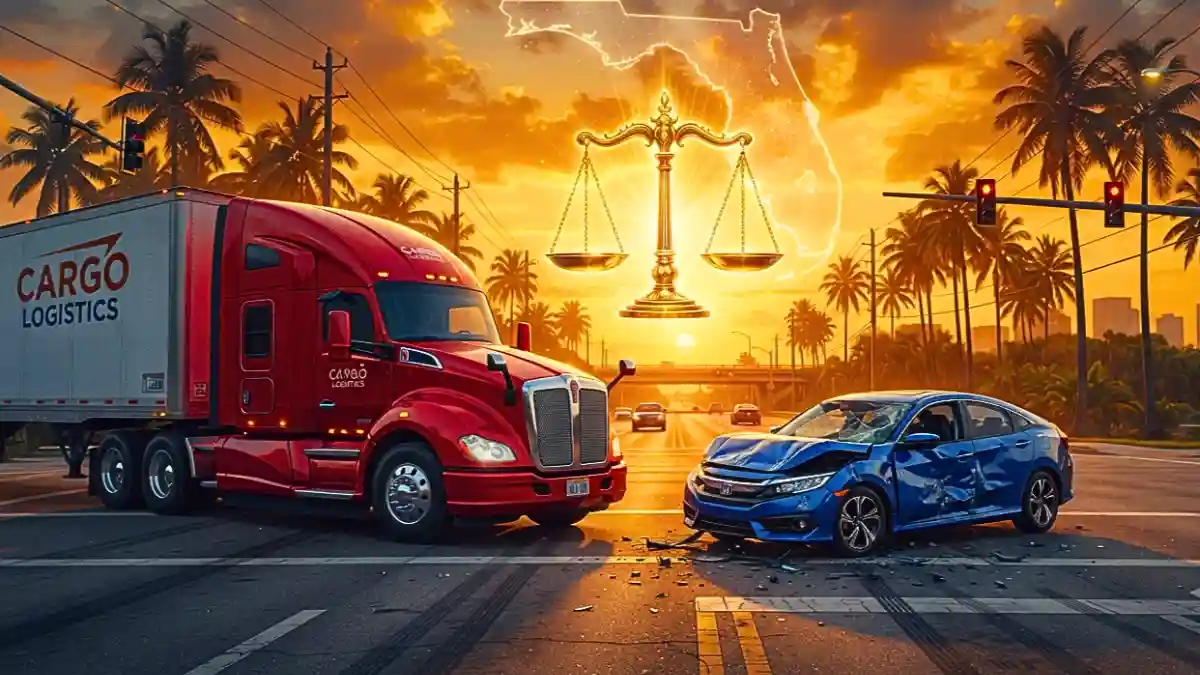
If you’ve ever been in a fender-bender in Florida traffic, you already have some sense of how a car accident claim works: two drivers, two insurance policies, and a fault determination based on who ran the light or who was following too closely. But the moment an 18-wheeler or a box truck is involved, the entire equation changes. Suddenly there’s a trucking company, a cargo owner, a maintenance contractor, and sometimes a truck manufacturer all sitting on the other side of the table.
If you’re trying to figure out who’s actually on the hook for your medical bills, lost wages, and vehicle damage after a crash, the honest answer is: it depends on what kind of crash you were in. This guide breaks down exactly how liability works in a standard Florida car accident versus a commercial truck accident, why the trucking side of the equation is so much more complicated, and what that means for the size and difficulty of your claim.
Why This Distinction Actually Matters
At first glance, a crash is a crash — metal meets metal, someone gets hurt, someone should pay. But Florida law, federal regulations, and the insurance industry treat truck accidents very differently from ordinary car accidents for a few key reasons:
- The scale of the damage. A fully loaded semi-truck can weigh up to 80,000 pounds, compared to roughly 4,000 pounds for the average passenger car. That weight disparity means truck accidents are far more likely to cause catastrophic injury or death, which drives up claim values dramatically.
- The number of potentially liable parties. A car accident usually involves two drivers. A truck accident can involve the driver, the trucking company, a leasing company, a maintenance vendor, a cargo loading company, and even a parts manufacturer.
- Federal regulation. Commercial trucks and their drivers are regulated by the Federal Motor Carrier Safety Administration (FMCSA), which layers an entirely separate set of rules — and separate ways to prove negligence — on top of ordinary Florida traffic law.
- Insurance minimums. Commercial trucking companies are required to carry far higher liability insurance limits than a typical driver, which changes how insurers investigate and defend claims.
Understanding these differences isn’t just academic. It determines who your legal team needs to investigate, what evidence needs to be preserved (and how quickly), and ultimately how much compensation is realistically available to you.
Also Read – What to Do Immediately After a Car Accident in Florida: A Step-by-Step Guide
How Liability Works in a Standard Florida Car Accident
Florida’s Move to Modified Comparative Negligence
For decades, Florida operated under a “pure comparative negligence” system. Under that older rule, an injured driver could recover damages from another at-fault driver no matter how much fault they themselves carried — even someone found 90% responsible for their own crash could recover the remaining 10% of their damages.
That changed in 2023. Florida switched from pure comparative negligence to modified comparative negligence when Governor Ron DeSantis signed House Bill 837 into law, with the new rule effective for cases arising on or after March 24, 2023. Under the modified system, an injured person can still recover damages as long as they are found to be 50% or less at fault for the accident, but a plaintiff found more than 50% responsible is barred from recovering any compensation at all. For everyone else who is 50% or less at fault, their damages award is reduced in proportion to their own share of fault.
So if a jury determines you suffered $200,000 in damages but were 30% at fault for the crash, you’d recover $140,000. But if that same jury found you 51% at fault, you would recover nothing — regardless of how severe your injuries were. This is one of the single most important legal changes for anyone dealing with an accident claim in Florida today, and it’s a big part of why insurance companies fight so hard over fault percentages, even in seemingly straightforward crashes.
It’s also worth noting that this 51% bar generally applies to standard negligence claims — medical malpractice cases are carved out and still follow the older pure comparative negligence rule.
Common Liability Scenarios in Car Accidents
In a typical two-vehicle car accident, fault usually comes down to traffic law violations and driver behavior:
- Rear-end collisions — Generally presumed to be the fault of the trailing driver, though this presumption can be rebutted with evidence of sudden stops, brake-light failure, or reckless lane changes.
- Left-turn accidents — Usually the fault of the driver making the left turn unless they had the right of way or the oncoming driver was speeding or ran a red light.
- Intersection collisions — Determined by right-of-way rules, traffic signals, and witness or camera evidence.
- Distracted or impaired driving — Texting, phone use, or driving under the influence can shift substantial or total fault onto that driver.
Because Florida no longer requires you to carry Personal Injury Protection (PIP) coverage to sue for pain and suffering the way older rules once did in some circumstances, most serious car accident cases still move through the traditional negligence framework: you must show the other driver owed you a duty of care, breached that duty, and caused your damages as a result.
Also Read – The Discovery Phase in Personal Injury Lawsuits Explained Step-by-Step
Evidence in Car Accident Claims
Because most car accidents involve only the two drivers, evidence gathering tends to be relatively contained:
- Police crash reports
- Photos of vehicle damage and the accident scene
- Witness statements
- Traffic camera or dashcam footage, if available
- Vehicle damage estimates and medical records
Insurance adjusters typically resolve these claims by comparing the physical evidence against each driver’s account, and settlements are usually reached within the limits of a standard auto policy — often between $25,000 and $100,000 in liability coverage, depending on the policy.
Also Read – Can You Reopen a Personal Injury Settlement After Signing a Release Form?
How Liability Works in a Commercial Truck Accident
Commercial truck accident cases look completely different, and that’s true from the very first phone call an attorney makes after being retained. Instead of a single at-fault driver, you’re often dealing with a layered chain of responsibility.
Potentially Liable Parties in a Truck Accident
1. The Truck Driver Just like in a car accident, the driver can be liable for direct negligence — speeding, distracted driving, fatigue, following too closely, or violating traffic laws. But truck drivers are also subject to federal hours-of-service rules limiting how long they can drive without rest, which creates an additional avenue for proving negligence: driving beyond legal hour limits.
2. The Trucking Company (Motor Carrier) This is often where the real money is. Trucking companies can be held liable under a legal theory called vicarious liability or respondeat superior, which holds an employer responsible for the negligent acts of an employee performed within the scope of employment. Beyond that, companies can be independently negligent for:
- Negligent hiring (putting an unqualified or unsafe driver behind the wheel)
- Negligent training or supervision
- Pressuring drivers to exceed hours-of-service limits to hit delivery deadlines
- Failing to properly maintain the truck fleet
- Ignoring a driver’s known history of violations or prior accidents
3. The Owner of the Truck or Trailer In many cases, the truck, the trailer, and the driver aren’t all owned by the same entity. Independent owner-operators may lease their trucks to a larger carrier, which can create disputes over which company is actually responsible.
4. Cargo Loading Companies Improperly loaded or secured cargo is a major cause of truck accidents — particularly rollovers and jackknife crashes. If a third-party loading company packed the trailer unsafely, that company can bear liability independent of the driver or trucking company.
5. Truck and Parts Manufacturers If the crash was caused by a mechanical failure — defective brakes, tires, steering components, or coupling systems — the manufacturer of that part can be liable under Florida’s product liability laws, separate from any negligence claim against the driver or carrier.
6. Maintenance Contractors Many trucking companies outsource vehicle maintenance. If a third-party mechanic or maintenance shop failed to catch or fix a known defect, that company may share liability.
Also Read – What Is a Demand Letter? Key Components That Maximize Your Settlement Offer
Federal Regulations Change the Negligence Standard
This is one of the biggest differences between a car accident and a truck accident case. Car accidents are governed almost entirely by Florida traffic law and general negligence principles. Truck accidents add an entire layer of federal law on top of that, primarily through FMCSA regulations covering:
- Maximum driving hours and required rest breaks (hours-of-service rules)
- Mandatory drug and alcohol testing after accidents
- Vehicle inspection, maintenance, and repair recordkeeping
- Weight limits and cargo securement standards
- Driver qualification requirements (medical certification, licensing, training)
When a trucking company or driver violates one of these federal safety regulations and that violation contributes to a crash, it can serve as powerful evidence of negligence — in some cases even supporting a claim of negligence per se, where the violation of a safety regulation designed to prevent this type of harm is treated as strong evidence the defendant failed to meet the required standard of care.
Higher Insurance Requirements Change the Stakes
Commercial trucking companies operating in interstate commerce are required to carry significantly higher liability insurance minimums than ordinary drivers — typically $750,000 or more, and up to $5 million for trucks hauling hazardous materials. Compare that to Florida’s relatively low minimum insurance requirements for private passenger vehicles, and it’s easy to see why truck accident cases tend to involve far more aggressive insurance defense teams, faster-moving investigation units, and much higher settlement values when liability is clear.
That higher insurance exposure is exactly why trucking companies often deploy a “rapid response team” — sometimes including their own investigators and attorneys — to the scene of a serious crash within hours. Their goal is to gather favorable evidence and control the narrative before an injured victim has retained legal counsel of their own.
Evidence in Truck Accident Claims
Because so many parties can be involved, and because federal regulations create additional documentation requirements, truck accident cases involve a much wider evidence net:
- The truck’s electronic logging device (ELD) data, showing hours driven and rest breaks
- The “black box” or event data recorder, which can show speed, braking, and throttle data in the moments before the crash
- Driver qualification files and employment history
- Maintenance and inspection records
- Drug and alcohol test results (federally required after serious crashes)
- Cargo manifests and loading records
- Dispatch records and delivery schedules
- The trucking company’s safety rating and FMCSA compliance history
Much of this evidence is time-sensitive. Trucking companies are not required to retain electronic logs, dashcam footage, or maintenance records indefinitely, and some of it can be routinely overwritten or destroyed within weeks unless a formal preservation letter (a “spoliation letter”) is sent quickly after the crash. This is one of the most important practical differences between the two types of cases: in a truck accident, delay can mean losing access to the very evidence that proves your case.
Comparative Negligence Still Applies — But It Gets More Complicated
Florida’s modified comparative negligence rule applies to truck accidents just as it does to car accidents. If you’re found more than 50% at fault, you can’t recover damages; if you’re 50% or less at fault, your award is reduced proportionally. What changes in a truck accident case is how fault gets apportioned among multiple defendants.
Because a truck crash may involve negligence by the driver, negligence by the trucking company, and a mechanical defect from a manufacturer, a jury may need to divide fault across several parties, not just between the two drivers. This is where Florida’s rules on joint and several liability, and the specific allocation of fault by percentage among named defendants, become critical. An experienced attorney will typically name every potentially liable party at the outset so that the full picture of fault — and the full range of available insurance coverage — is on the table from the start.
Damages: What You Can Recover in Either Type of Claim
Whether you’re dealing with a car accident or a truck accident, Florida law generally allows you to pursue similar categories of damages:
- Economic damages — medical bills, future medical care, lost wages, lost earning capacity, property damage
- Non-economic damages — pain and suffering, emotional distress, loss of enjoyment of life
- Wrongful death damages — in fatal cases, survivors may recover funeral expenses, loss of support, and loss of companionship
The practical difference is scale. Because truck accidents tend to produce more catastrophic injuries — traumatic brain injuries, spinal cord damage, amputations, and fatalities are all disproportionately common in truck crashes compared to car-on-car collisions — the damages claimed, and the insurance policies available to pay them, tend to be significantly larger.
Statute of Limitations: Don’t Wait
Florida’s statute of limitations for most personal injury claims, including both car and truck accidents, is generally four years from the date of the accident for negligence claims, and two years for wrongful death claims. While that may sound like plenty of time, waiting is almost always a mistake — especially in truck accident cases, where critical evidence can disappear within weeks if it isn’t formally preserved. Speaking with an attorney early doesn’t commit you to filing a lawsuit immediately, but it does protect your ability to gather the evidence you’ll need if your case doesn’t settle quickly.
Practical Steps After Each Type of Accident
After a Car Accident
- Call 911 and request a police report.
- Exchange insurance and contact information with the other driver.
- Photograph the scene, vehicle damage, and any visible injuries.
- Seek medical evaluation, even if you feel fine initially.
- Report the accident to your own insurer, but avoid giving a recorded statement to the other driver’s insurer without legal advice.
After a Commercial Truck Accident
- Call 911 — a police report is essential, and a serious truck crash may also require a hazmat or commercial vehicle inspector.
- Get the truck’s DOT number, license plate, and the name of the motor carrier printed on the truck if visible.
- Photograph everything: the truck, the trailer, cargo spillage, skid marks, and road conditions.
- Seek medical care immediately, given the higher likelihood of serious injury.
- Contact an attorney quickly to send a spoliation/evidence preservation letter to the trucking company before logs, black box data, or maintenance records can be lost or overwritten.
- Avoid speaking with the trucking company’s insurance representatives or “rapid response” investigators without legal counsel present.
Why Insurance Companies Treat These Claims So Differently
It’s worth understanding the business incentives at play, because they explain a lot about how each type of claim actually unfolds in practice.
A standard auto insurer handles an enormous volume of car accident claims every year. Adjusters are typically working from a playbook: compare the police report, the damage estimates, and the medical records against internal guidelines, then make an offer that fits within a fairly predictable range. There’s room to negotiate, especially on pain-and-suffering damages, but the process is largely standardized.
Commercial trucking insurers operate differently because the financial exposure on any single claim can be enormous. A catastrophic truck accident claim can easily exceed the underlying policy limits, which means the insurer has a strong financial incentive to minimize its payout — or avoid it altogether by shifting fault onto the injured victim or onto a third party. This is part of why trucking companies frequently:
- Dispatch rapid-response teams to accident scenes before the wreckage is even cleared
- Retain accident reconstruction experts within days of a serious crash
- Attempt to obtain recorded statements from injured victims before they’ve retained an attorney
- Push aggressively for an early, lower settlement before the full extent of injuries is known
None of this is inherently improper — it’s simply a reflection of how much more is financially at stake in a commercial trucking claim. But it does mean that injured victims are often at a significant disadvantage if they try to negotiate directly with a trucking company’s insurer without legal representation, especially in the early days after a crash when medical needs and evidence gaps are still being sorted out.
Frequently Asked Questions
Does Florida’s 51% fault rule apply the same way to truck accidents as it does to car accidents?
Ans: Yes. Florida’s modified comparative negligence standard, established under House Bill 837, applies to negligence-based personal injury claims generally, including both car accidents and commercial truck accidents. If you’re found more than 50% at fault, you cannot recover damages; at 50% or below, your recovery is reduced by your percentage of fault.
Can a trucking company be held liable even if the driver wasn’t a direct employee?
Ans: Often, yes. Many truck drivers operate as independent contractors or lease their trucks to a larger motor carrier. Depending on the contractual relationship and the degree of control the carrier exercised over the driver’s work, the carrier may still be held liable under theories of vicarious liability, negligent hiring, or negligent supervision — particularly if the carrier held itself out to the public as the operator of the truck.
What makes truck accident injuries different from car accident injuries?
Ans: Because of the massive weight and size disparity between commercial trucks and passenger vehicles, truck accidents are statistically more likely to result in catastrophic injuries — traumatic brain injuries, spinal cord damage, severe fractures, and fatalities — compared to typical car-on-car collisions. This drives up both the medical costs involved and the overall value of a claim.
How long do I have to file a claim after a Florida truck or car accident?
Ans: Florida generally allows four years from the date of the accident to file a negligence-based personal injury lawsuit, and two years for a wrongful death claim. That said, truck accident evidence — including electronic logs and black box data — can be lost far sooner than that if it isn’t formally preserved, so early action is strongly advised even though the filing deadline itself is further out.
Do I need a different type of attorney for a truck accident versus a car accident?
Ans: Not necessarily a different type of attorney, but you generally want one with specific experience handling commercial trucking cases. These cases require familiarity with FMCSA regulations, electronic logging device data, and multi-defendant litigation strategies that don’t typically come up in a standard two-car accident claim.
What if I was partly responsible for a truck accident?
Ans: You can still recover damages as long as a jury or insurer determines your share of fault was 50% or less, with your compensation reduced proportionally. Because insurers often try to shift blame onto the injured party specifically to trigger Florida’s 51% bar, it’s especially important to have your own investigation and evidence in truck accident cases where fault is contested.
Why This Distinction Should Shape Your Next Move
The core legal principles — negligence, causation, and Florida’s modified comparative fault rule — apply to both car and truck accidents. But the practical reality of pursuing a claim is nothing alike. A car accident claim usually involves two insurance policies and a relatively contained set of facts. A commercial truck accident claim can involve federal regulations, multiple corporate defendants, time-sensitive electronic evidence, and insurance policies worth many times more than a standard auto policy.
If you’ve been injured in a truck accident, the trucking company’s insurer and legal team are almost certainly already building their defense. Understanding who can actually be held liable — and how quickly that liability picture needs to be locked down — is the first step toward making sure you’re not leaving compensation on the table.
DISCLAIMER: This article is provided for general informational purposes and does not constitute legal advice. If you’ve been injured in a car or truck accident in Florida, consult a licensed Florida personal injury attorney to discuss the specific facts of your case.

About Jordan
Jordan is a content writer at SushilHelps, covering legal topics such as car accidents, personal injury claims, medical compensation, and marriage visas. Jordan focuses on providing clear, practical, and easy-to-understand information to help readers navigate legal and immigration processes across major international destinations. He is not an attorney and does not provide legal advice, but his work is backed by thorough research and a commitment to accuracy. Spotted something that needs a correction? Let us know.