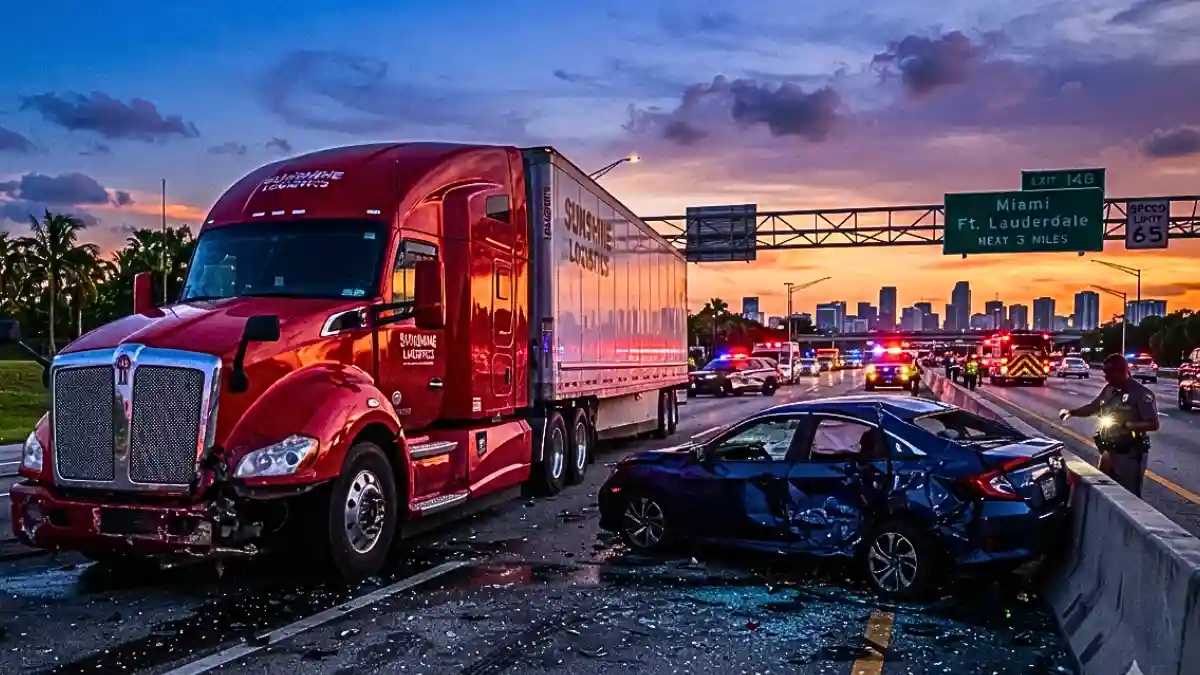
If you were hurt in a crash with a semi-truck, tractor-trailer, or other big rig on I-4, I-75, I-95, the Florida Turnpike, or any other Florida road, you are probably asking one urgent question: can I sue the trucking company itself, or am I stuck dealing only with the truck driver and whatever insurance the driver happens to carry?
The short answer is yes — in most cases, you can sue the trucking company directly. Florida law gives injured victims more than one legal path to hold a motor carrier financially responsible, and in many trucking crashes the company’s own decisions, policies, and hiring practices are just as much to blame as anything the driver did behind the wheel. But “yes, you can sue them” is only the beginning of the story. How strong that case is, how much you can recover, who else might share liability, and how quickly you need to act all depend on details specific to your crash and to Florida’s current legal landscape.
This guide walks through everything a Florida truck accident victim needs to understand as of August 2026, including recent legal developments — like a major U.S. Supreme Court ruling on freight broker liability and 2026 federal safety rule updates — that are actively shaping how these cases are built and won.
Why Truck Accident Cases Are Different From Ordinary Car Accident Claims
A collision between two passenger cars is usually a fairly contained legal dispute: two drivers, two insurance policies, and a relatively straightforward negligence analysis. A semi-truck collision is a different animal entirely.
A single loaded tractor-trailer can weigh up to 80,000 pounds — roughly 20 times heavier than the average sedan. That weight differential is why truck crashes so often produce catastrophic injuries: traumatic brain injuries, spinal cord damage, crush injuries, amputations, and wrongful death. It’s also why the legal and financial stakes are so much higher.
Behind almost every commercial truck on the road sits a web of businesses and regulations that simply don’t exist in a car-versus-car accident:
- A motor carrier (the trucking company) that owns or leases the truck
- A driver who may be a company employee or classified as an independent contractor
- A freight broker or logistics company that arranged the shipment
- A shipper that packed and loaded the cargo
- A maintenance or leasing company responsible for keeping the truck roadworthy
- Federal safety regulations issued by the Federal Motor Carrier Safety Administration (FMCSA) that govern hours of service, driver qualifications, vehicle maintenance, and drug and alcohol testing
Because so many parties can be involved, Florida law recognizes several distinct legal theories that let an injured person go after the trucking company directly rather than being limited to a claim against the driver alone.
Also Read – Dealing with Insurance Adjusters After a Crash in Florida: Mistakes to Avoid
Yes, You Can Sue the Trucking Company — Here’s the Legal Basis
There are two main legal doctrines that allow an injured victim to hold a Florida trucking company directly liable: vicarious liability and direct negligence. Many strong truck accident cases use both theories at once.
1. Vicarious Liability (Respondeat Superior)
Under the legal doctrine of respondeat superior — Latin for “let the master answer” — an employer is generally responsible for the negligent acts of an employee who was acting within the scope of employment when the harm occurred. In plain terms: if a company truck driver caused your crash while doing their job — driving a route, making a delivery, hauling a load for the company — the trucking company is typically on the hook for the resulting damages, even though the company itself didn’t personally do anything wrong in the moment of the crash.
This matters enormously for injured victims because individual truck drivers rarely carry enough personal insurance or personal assets to cover the kind of catastrophic damages a serious truck accident can cause. Trucking companies, by contrast, are required to carry substantial commercial liability insurance, and many carry policies well above the federal minimum. Suing the company under vicarious liability puts a much deeper pocket — and a real insurance policy — in play.
2. Direct Negligence by the Trucking Company
Separate and apart from vicarious liability, a trucking company can also be sued for its own independent negligence — conduct that had nothing to do with what the driver did in the moments before the crash, but that made the crash more likely to happen in the first place. Common direct negligence claims against Florida trucking companies include:
- Negligent hiring: Putting an unqualified, inexperienced, or unsafe driver behind the wheel of a commercial vehicle without properly vetting their driving record, criminal history, or qualifications.
- Negligent training: Failing to adequately train drivers on defensive driving, cargo securement, hours-of-service compliance, or how to operate specific equipment.
- Negligent supervision and retention: Keeping a driver on staff after learning about safety violations, prior accidents, drug or alcohol issues, or a pattern of complaints.
- Failure to maintain the vehicle: Skipping required inspections, ignoring known mechanical defects, or failing to keep brakes, tires, and lights in safe working condition.
- Scheduling pressure and hours-of-service violations: Setting delivery schedules so aggressive that drivers are effectively pressured to violate federal hours-of-service limits, drive while fatigued, or skip required rest breaks.
- Improper loading practices: When the company itself (rather than a separate third-party loader) is responsible for loading or securing cargo, and that cargo shifts, falls, or causes a rollover.
Direct negligence claims are powerful because a driver’s individual mistake — say, running a red light — can sometimes be chalked up to a single moment of poor judgment. A trucking company’s systemic failure to train its drivers or its decision to keep an unsafe driver on the road after multiple complaints tells a very different story to a jury, and it can support not just compensatory damages but, in cases of especially reckless conduct, punitive damages as well.
Also Read – Statute of Limitations for Car Accident Claims in Florida: Deadlines You Must Know
The “Independent Contractor” Defense — And Why It Often Doesn’t Work
Many trucking companies try to avoid liability by classifying their drivers as independent contractors rather than employees, arguing that respondeat superior doesn’t apply to contractors. This defense is common, but it is far from bulletproof. Federal motor carrier regulations often treat drivers operating under a motor carrier’s operating authority as “statutory employees” for liability purposes, regardless of how the relationship is labeled on paper. If the trucking company controlled the driver’s schedule, dictated the routes, owned or leased the truck, and required the driver to operate under its DOT number, courts often find that the company still bears responsibility, whatever the contract says. An experienced truck accident attorney knows how to investigate the real relationship between the driver and the carrier — not just the paperwork.
Beyond the Trucking Company: Other Parties Who May Share Liability
While the trucking company is often the primary target of a lawsuit, Florida’s modified comparative negligence system (discussed below) makes it important to identify every potentially liable party. Depending on the facts of your crash, you may also be able to bring claims against:
- The truck driver individually, particularly if their conduct was reckless, intoxicated, or intentional.
- A freight broker that arranged the shipment and negligently selected an unsafe or unqualified motor carrier. This area of law changed significantly in 2026 (more on that below).
- The shipper or cargo loader, if improperly loaded, overloaded, or unsecured cargo caused or contributed to the crash.
- A maintenance or repair company that performed faulty brake work, tire service, or other repairs that later failed.
- A truck or trailer manufacturer, if a defective part — such as brakes, tires, or coupling systems — caused or contributed to the collision, potentially giving rise to a product liability claim.
- A government entity, in the rare case where a dangerous road design, missing signage, or poor maintenance of the roadway itself contributed to the crash.
Because trucking crashes frequently involve overlapping layers of responsibility, a thorough investigation — including obtaining the truck’s electronic logging device (ELD) data, the engine control module (“black box”) data, driver qualification files, maintenance records, and dispatch records — is often essential to identifying every party who should be named in a lawsuit.
Also Read – Average Settlement Value for a Rear-End Collision in Florida: What to Expect
Major 2026 Legal Development: The Supreme Court’s Freight Broker Ruling
One of the most significant developments affecting Florida truck accident litigation this year came from the U.S. Supreme Court. On May 14, 2026, the Court decided Montgomery v. Caribe Transport II, LLC, ruling that negligent-hiring claims against freight brokers are not automatically barred by the Federal Aviation Administration Authorization Act (FAAAA) when the claim involves motor vehicle safety.
Before this ruling, freight brokers — the companies that arrange shipments by matching shippers with motor carriers, without owning trucks themselves — frequently argued that federal preemption under the FAAAA gave them blanket immunity from state-law negligence claims. The Supreme Court’s decision closed that loophole for safety-related claims. Now, if a broker negligently selected an unsafe, unqualified, or poorly-vetted trucking company to haul a load — for example, a carrier with a documented history of hours-of-service violations, out-of-service orders, or unqualified drivers — the injured victim may be able to pursue a negligent-selection claim against the broker under Florida law.
This doesn’t mean every truck accident case now includes a broker as a defendant; the injured party still has to prove that the carrier was unfit, that the broker knew or should have known about the carrier’s unfitness, and that this unfitness caused the crash. But for victims of crashes involving less reputable trucking companies working under brokered loads, this ruling opens up a meaningful new avenue for recovery — and a new pool of insurance coverage — that simply wasn’t reliably available before 2026.
2026 Federal Safety Rule Changes and What They Mean for Your Case
The FMCSA periodically updates federal safety regulations covering hours-of-service limits, commercial driver’s license (CDL) standards, and electronic logging device requirements. Florida generally adopts current federal motor carrier safety regulations for interstate carriers, meaning that as 2026 FMCSA rule updates take effect, they become immediately enforceable for interstate truckers operating in Florida.
There’s an important wrinkle here that many accident victims never learn about: Florida applies a different regulatory timeline to intrastate carriers — trucking companies operating entirely within the state. For intrastate commerce, Florida has adopted the federal safety regulations as they existed on December 31, 2023, creating a lag between the rules that apply to interstate truckers passing through Florida and those that apply to local, in-state carriers. This distinction can matter significantly when your attorney is evaluating whether a particular trucking company violated the safety standards applicable to it at the time of your crash.
Why does this matter for a lawsuit? Under Florida law, a violation of a federal safety regulation can serve as strong evidence of negligence. If a trucking company or driver violated hours-of-service rules, skipped a required inspection, or failed to meet CDL qualification standards, that violation can become a central piece of evidence supporting your negligence claim — and if the violation was particularly reckless or repeated, it can support a claim for punitive damages as well. A company’s history of citations, safety violations, or out-of-service orders often only comes to light through a focused investigation, which is one of the many reasons early legal representation matters in these cases.
Also Read – Commercial Truck Accident vs. Car Accident: Who Is Actually Liable for Damages in Florida?
What You Have to Prove: The Elements of a Florida Truck Accident Negligence Claim
Whether you’re suing the driver, the trucking company, a broker, or all of the above, a truck accident lawsuit in Florida is built on the same basic framework: negligence. To win, you generally need to establish four elements:
- Duty: The defendant owed you a legal duty of care. Truck drivers owe a duty to operate their vehicles safely; trucking companies owe a duty to hire, train, supervise, and equip their drivers properly, and to maintain their vehicles in safe operating condition.
- Breach: The defendant breached that duty — for example, by speeding, driving while fatigued, failing to maintain the brakes, or ignoring a known safety issue with a driver.
- Causation: The breach actually caused your accident and your injuries.
- Damages: You suffered real, compensable harm — medical bills, lost wages, pain and suffering, property damage, or in the worst cases, wrongful death.
Direct negligence claims against the trucking company follow this same structure, just applied to the company’s own conduct (hiring, training, maintenance, scheduling) rather than the driver’s moment-of-crash decisions.
Florida’s Modified Comparative Negligence Rule — And Why It Matters More Than Ever
One of the most consequential changes to Florida injury law in recent years came from House Bill 837 (HB 837), signed into law in March 2023, which overhauled how fault is allocated in Florida negligence cases — including truck accident cases.
Before HB 837, Florida used a “pure” comparative negligence system, which allowed an injured plaintiff to recover damages no matter how much of the fault was theirs, even if a jury found them 99% responsible. HB 837 replaced that system with a modified comparative negligence rule, codified at Florida Statute § 768.81(6): if you are found to be more than 50% at fault for your own injuries, you are barred from recovering any damages at all. If you are found to be 50% or less at fault, your damages award is simply reduced by your percentage of fault.
For example, if a jury awards you $1,000,000 in damages but finds you were 30% at fault for the crash, you would recover $700,000. But if that same jury found you 51% at fault, you would recover nothing, regardless of how severe your injuries were.
This rule makes it critically important for truck accident victims to build a strong, well-documented case from the very beginning. Trucking companies and their insurers have every incentive to argue that you share significant fault for the crash, precisely because doing so can eliminate their liability entirely if they can push your fault share past the 50% line. This is one of the many reasons truck accident cases benefit from early evidence preservation — dashcam footage, witness statements, event data recorder information, and skid mark analysis can all be critical to accurately establishing how much fault belongs to each party.
The Florida Statute of Limitations: You Have Less Time Than You Think
Perhaps the single most important practical fact in this entire article: Florida gives you only two years from the date of the accident to file a personal injury lawsuit.
This is also a product of HB 837, which cut Florida’s previous four-year statute of limitations for negligence claims in half, under Florida Statute § 95.11. If your accident happened before the law’s effective date of March 24, 2023, the older four-year window may still apply, but for virtually all crashes happening now, the two-year clock applies. If you have lost a family member in a fatal truck accident, Florida’s wrongful death statute of limitations also generally runs two years from the date of death.
Missing this deadline is not a minor inconvenience — it typically and permanently bars your ability to recover anything at all, no matter how strong your case would otherwise have been. Because truck accident cases often require extensive investigation — subpoenaing ELD data, engine control module downloads, maintenance logs, and driver qualification files before they can be lost, overwritten, or “routinely” destroyed — waiting even a few months to consult an attorney can meaningfully weaken your case, even though you technically remain within the statutory deadline.
What Kind of Compensation Can You Recover?
If you successfully hold a trucking company liable for your injuries, Florida law allows you to pursue several categories of damages:
- Economic damages, including past and future medical expenses, lost wages, lost future earning capacity, and property damage to your vehicle.
- Non-economic damages, including pain and suffering, emotional distress, and loss of enjoyment of life.
- Punitive damages, in cases involving especially reckless or intentional misconduct — for example, a trucking company that knowingly kept an unfit driver on the road, or a driver who was intoxicated at the time of the crash. Punitive damages are meant to punish egregious conduct and deter similar behavior in the future, and Florida law caps most punitive damages awards, with exceptions for particularly severe misconduct.
- Wrongful death damages, for surviving family members, which can include funeral and burial expenses, loss of financial support, and loss of companionship.
Because commercial trucks are required to carry substantially more insurance than passenger vehicles, the available compensation in a successful truck accident case is often far higher than in an ordinary car accident claim. Federal regulations generally require motor carriers to maintain a minimum of $750,000 in liability coverage, though carriers hauling hazardous materials or operating larger vehicles may be required to carry $1,000,000 or more, and many trucking companies carry substantially higher policy limits or umbrella coverage on top of the federal minimum. In addition to the trucking company’s commercial policy, injured victims may also have access to their own Florida Personal Injury Protection (PIP) coverage, underinsured/uninsured motorist coverage if the at-fault party’s policy proves insufficient, and cargo or umbrella policies where applicable.
Given the catastrophic injuries and high-value policies often involved, truck accident cases involving serious or permanent injuries routinely settle — or result in jury verdicts — well into the six- and seven-figure range.
Why Trucking Companies Fight Hard — And Fight Fast
It’s worth understanding what you’re up against. Trucking companies and their insurers know that a serious truck accident claim can expose them to substantial liability, and many large carriers have well-rehearsed rapid-response protocols. It is not uncommon for a trucking company to dispatch its own investigators, adjusters, and even attorneys to a crash scene within hours of the collision — sometimes before an injured victim has even been released from the hospital. Their goal in those early hours is often to gather evidence favorable to the company, obtain recorded statements that can be used to minimize the claim later, and, in some cases, begin the process of preserving (or, less charitably, controlling) evidence like black box data.
This asymmetry is a major reason personal injury attorneys who focus on trucking litigation emphasize acting quickly. The sooner a spoliation letter can be sent demanding preservation of ELD data, dashcam footage, dispatch records, and maintenance logs, the less likely that critical evidence disappears before your case is built.
Steps to Take If You’ve Been in a Florida Semi-Truck Collision
If you’ve been involved in a crash with a commercial truck in Florida, the following steps can help protect both your health and your legal rights:
- Seek medical attention immediately, even if your injuries seem minor at first. Some serious injuries, including traumatic brain injuries and internal injuries, are not immediately obvious.
- Report the accident to law enforcement. A Florida Highway Patrol or local law enforcement crash report is critical evidence, and Florida law generally requires reporting for crashes above certain damage or injury thresholds.
- Document everything you can safely document — photos of the vehicles, the scene, skid marks, cargo, road conditions, and visible injuries, along with contact information for any witnesses.
- Avoid giving recorded statements to the trucking company’s insurer before speaking with an attorney. Insurance adjusters are trained to ask questions designed to minimize the company’s liability.
- Preserve evidence quickly. Consider having an attorney send a formal spoliation letter to the trucking company demanding preservation of ELD data, black box data, driver logs, and maintenance records before they can be lost or overwritten.
- Consult a Florida truck accident attorney as soon as possible. Given the two-year statute of limitations, the complexity of identifying every liable party, and the sophistication of trucking company defense teams, early legal guidance can make a substantial difference in the outcome of your case.
Frequently Asked Questions
Can I sue a trucking company if the driver was technically an independent contractor?
Ans: Often, yes. Courts frequently look past how a driver is labeled on paper and examine the real working relationship — including who controlled the driver’s schedule, routes, and equipment, and under whose federal operating authority the driver was operating.
What if I was partially at fault for the crash?
Ans: You can still recover compensation as long as a jury finds you were 50% or less at fault, though your recovery will be reduced by your percentage of fault. If you’re found more than 50% at fault, Florida law bars any recovery.
How long do I have to file a lawsuit after a Florida truck accident?
Ans: Generally two years from the date of the accident under Florida’s current statute of limitations, though certain circumstances can affect this deadline. Because evidence can be lost quickly, don’t wait until close to the deadline to seek legal advice.
Can I sue the freight broker that arranged the shipment?
Ans: Following the U.S. Supreme Court’s 2026 ruling in Montgomery v. Caribe Transport II, LLC, freight brokers can potentially be held liable under state-law negligent-hiring or negligent-selection theories when they failed to use reasonable care in selecting a motor carrier, and that failure contributed to your crash.
Do I need a lawyer to sue a trucking company?
Ans: You are not legally required to have an attorney, but trucking litigation is among the most complex areas of personal injury law, involving federal regulations, multiple potentially liable parties, sophisticated corporate defense teams, and technical evidence like ELD and black box data. Most truck accident attorneys handle these cases on a contingency-fee basis, meaning you pay nothing upfront and only owe fees if you recover compensation.
Final Thoughts
Yes — in most circumstances, you can sue a trucking company directly after a semi-truck collision in Florida, whether through vicarious liability for the driver’s actions, direct negligence claims based on the company’s own hiring, training, or maintenance failures, or in some cases, claims against the broker that arranged the shipment. But successfully pursuing that claim requires navigating Florida’s modified comparative negligence rule, a strict two-year statute of limitations, evolving federal safety regulations, and a well-resourced trucking industry that moves quickly to protect itself after a crash.
If you or a loved one has been injured in a truck accident in Florida, the facts of your specific case — who was involved, what caused the crash, and what evidence is available — will determine the strongest path forward. Speaking with an experienced Florida truck accident attorney as soon as possible is the best way to understand your options and protect your right to full and fair compensation.
Disclaimer: This article is for general informational purposes only and does not constitute legal advice. Every truck accident case is different, and only a licensed Florida attorney who has reviewed the specific facts of your crash can tell you how the law applies to your situation. If you’ve been injured in a truck accident, consider speaking with a Florida truck accident lawyer as soon as possible.

About Jordan
Jordan is a content writer at SushilHelps, covering legal topics such as car accidents, personal injury claims, medical compensation, and marriage visas. Jordan focuses on providing clear, practical, and easy-to-understand information to help readers navigate legal and immigration processes across major international destinations. He is not an attorney and does not provide legal advice, but his work is backed by thorough research and a commitment to accuracy. Spotted something that needs a correction? Let us know.